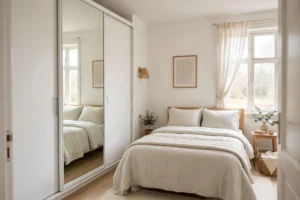

Sharing a bed does not mean sharing the same sleep needs. One partner may fall asleep in minutes while the other reads for an hour. One may run hot while the other reaches for an extra blanket at midnight. One may wake at 5 a.m. for work while the other sleeps until 8. These differences are normal, and they do not have to lead to tired mornings or separate rooms. The best bedroom ideas for couples start with a simple shift: stop trying to force one sleep setup on two people, and build a room that gives each person a little control. Small changes often work better than big ones. Two thinner duvets instead of one heavy one, a reading light that stays on one side, a mattress that absorbs movement, and a clear plan for morning noise can change how rested you both feel. This guide covers 15 practical ideas that real couples use, with sizes, costs, and honest limits. Use the ones that fit your room, your budget, and the exact way you sleep.
1. Try a Split Mattress Setup for Different Firmness Needs
A split mattress setup gives each side of the bed its own firmness, so a side sleeper who needs soft pressure relief and a back sleeper who needs firm support can both sleep well on the same frame. For a king bed, that means two twin XL mattresses, each 38 by 80 inches, placed side by side. For a queen, look for split-top designs where only the top third separates, or choose a king frame if your room allows it. Prices range from about $600 for two budget foam twin XLs to $2,000 or more for quality hybrid models. Place a thin mattress topper bridge or a fitted sheet made for split kings over the join to reduce the gap. Avoid buying two very different heights, because a height gap of more than half an inch feels like a ridge all night. Tip: test firmness in store for at least 10 minutes per side, lying in your usual sleep position, before you commit.

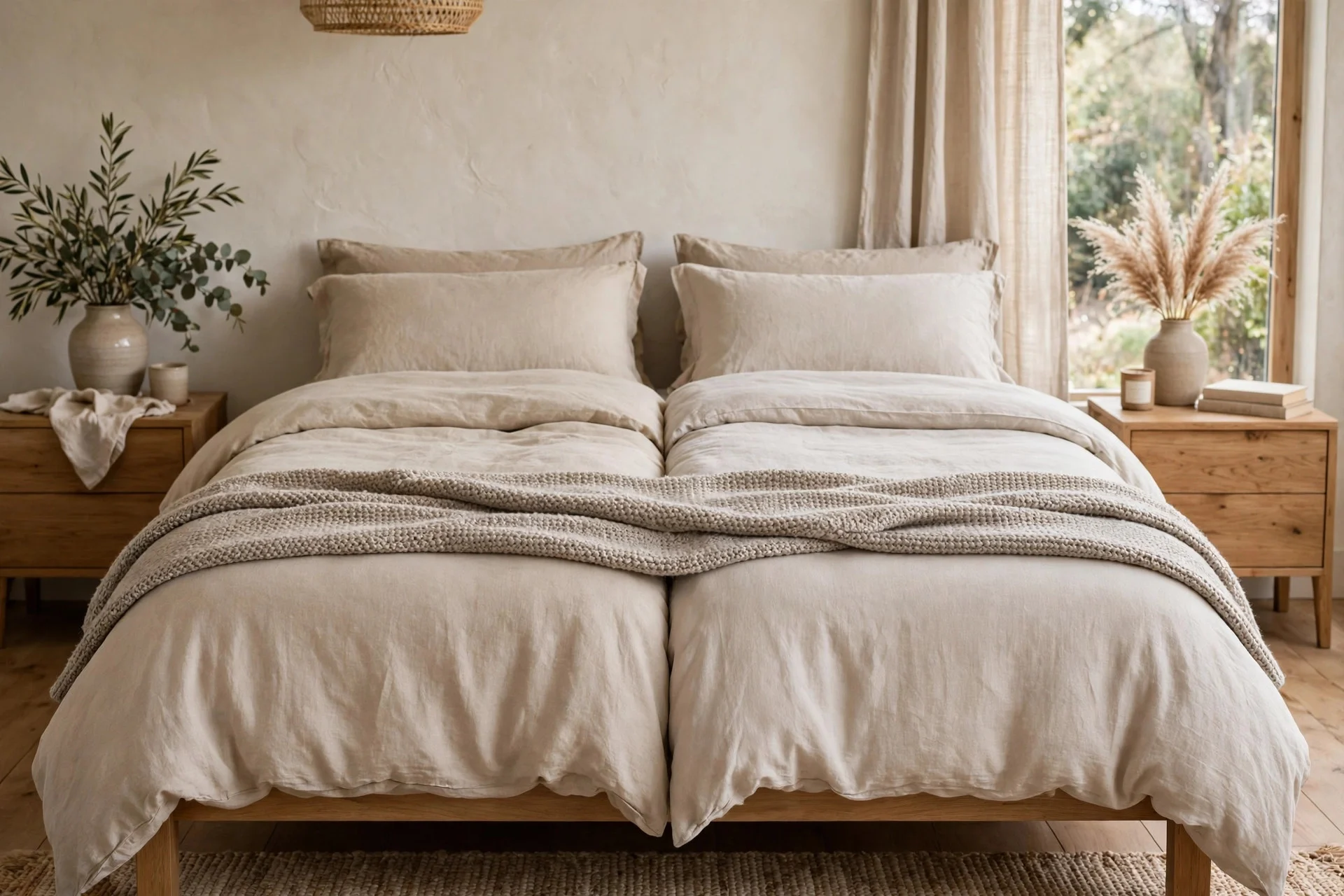
2. Use Two Separate Duvets Instead of One Shared Cover
Two separate duvets, often called the Scandinavian sleep method, solve the nightly tug-of-war over covers and let a hot sleeper and a cold sleeper choose different weights. Each person gets a twin or twin XL duvet on a king bed, or a slightly oversized twin on a queen. A lightweight cotton duvet insert costs $40 to $90, while a down or down-alternative version runs $80 to $180 each. Lay them side by side with a small overlap in the middle, and add a shared throw across the foot of the bed so the bed still looks made. Avoid very heavy duvets for the hot sleeper, since extra weight traps heat even in a cool room. Tip: use different coloured duvet covers for a few weeks at first, so you can quickly tell whose cover is whose when making the bed.
3. Add an Adjustable Base So Each Side Moves on Its Own
A split adjustable base lets one partner raise their head to read or ease snoring while the other stays flat, without waking anyone. Split king adjustable bases fit two twin XL mattresses and usually cost $1,200 to $2,500 for the pair, including motors and remotes. Check that your headboard, frame, and bedroom door width can handle delivery, since each base is heavy and roughly 38 inches wide. Most models offer head and foot lift, a flat preset, and a zero-gravity preset. Avoid buying a single adjustable base for a couple with very different needs, because one motor cannot serve two positions at once. Tip: set the remotes to different sides of the bed and label them, so a half-asleep reach in the dark does not move the wrong side.

4. Create a Cool Side and a Warm Side With Layered Bedding
Temperature is one of the biggest sleep differences between partners, and layered bedding lets you fix it without changing the thermostat for the whole house. Put a breathable cotton or linen sheet and a light quilt on the hot side, and add a fleece throw or heavier duvet on the cold side. A good linen sheet set costs $60 to $140, and a quality throw runs $30 to $80. Keep the room itself between 60 and 67 degrees Fahrenheit, which suits most sleepers, then adjust with layers rather than room heat. Avoid thick polyester bedding on the hot side, because it holds heat and sweat even when the room feels cool. Tip: keep the extra blanket folded at the foot of the cold side, so it is easy to grab at 2 a.m. without turning on a light.

5. Block Early Morning Light on One Side Only
If one partner wakes early and the other needs darkness, you do not need to darken the whole room the same way. Fit blackout curtains on the window nearest the late sleeper, and use a lighter sheer or roller blind on the early riser’s side. A blackout curtain panel 84 inches long costs $25 to $70, and a ceiling-mounted track lets curtains slide fully past the window frame for better coverage. Mount the rod 4 to 6 inches above the frame and 3 to 4 inches wider on each side to cut light leaks. Avoid thin curtains sold as blackout that still let a clear glow through when held up to a lamp. Tip: test the setup at sunrise on a weekend before workdays depend on it, and add a small eye mask as backup for the light-sensitive partner.

6. Use Sound Zoning for a Snorer and a Light Sleeper
Sound differences need a plan that helps the light sleeper without making the snorer feel blamed. A white noise machine placed near the light sleeper’s side, about 3 to 5 feet from the pillow, can mask snoring, traffic, and early alarms. Machines cost $25 to $70, and many offer fan, rain, and brown noise settings. Pair it with soft earplugs rated around 22 to 32 decibels if noise is still an issue, and keep the volume low enough that you can still hear a smoke alarm. Avoid placing the machine right against the snorer’s pillow, because it will not mask sound from that close range. Tip: run the machine all night on the same setting, since a machine that switches off at 3 a.m. can wake a light sleeper more than steady sound does.

7. Give Each Partner Their Own Pillow Height and Fill
Pillow needs vary by sleep position, neck pain, and heat, so a matched pair often leaves one person uncomfortable. Side sleepers usually need a firmer, higher pillow about 5 to 7 inches thick to keep the neck level. Back sleepers do better with a medium pillow around 4 to 5 inches, and stomach sleepers need a thin, soft pillow under 3 inches. A quality pillow costs $30 to $90, and many brands offer a 30-night trial. Replace pillows every 18 to 24 months, or sooner if they stay flat after folding. Avoid buying two of the same pillow just because they look neat on the bed. Tip: write each person’s pillow type on a small tag inside the pillowcase, so a wash day does not mix them up again.

8. Install Separate Reading Lights With Narrow Beams
Separate reading lights let a night owl read while an early sleeper falls asleep undisturbed. Wall-mounted reading lights with a narrow, focused beam work best, placed 18 to 24 inches above the mattress and angled down toward the book, not across the bed. A good pair costs $40 to $120, and warm light around 2700 Kelvin feels less harsh at night than bright white light. Clip-on book lights cost $15 to $30 and work well in rented rooms where you cannot drill. Avoid overhead lights and bright bedside lamps with open shades, because they spread light across both pillows. Tip: choose lights with a dimmer and a memory setting, so the reader can return to the same low level every night without fiddling.

9. Set Up Two Alarms That Do Not Wake Both People
An early alarm should wake one person, not both. A vibrating alarm watch or a bed shaker placed under the early riser’s pillow costs $30 to $80 and wakes only the wearer in most cases. A sunrise alarm clock on the early side, set to a low volume and pointed away from the other pillow, is another option at $40 to $100. Place phones face down on the early riser’s nightstand, not in the middle of the bed, and agree on a snooze limit before the week starts. Avoid loud phone alarms on a hard nightstand in the centre of the room, because the sound bounces and wakes the late sleeper too. Tip: test the vibrating alarm on a weekend morning first, so a failed test does not mean a missed workday.

10. Choose a Mattress That Absorbs Movement
Motion transfer ruins sleep when one partner tosses, turns, or gets up at night. Memory foam and pocketed-coil hybrid mattresses absorb movement far better than traditional innerspring models with connected coils. Look for a mattress at least 10 to 12 inches thick, with individually wrapped coils or dense foam layers, in the $800 to $1,800 range for a king. A split king setup helps even more, since movement stops at the gap between mattresses. Avoid thin, bouncy mattresses under 8 inches if either partner moves a lot, because they pass every shift straight across the bed. Tip: lie on one side while your partner rolls over in store, and repeat the test at home during the trial period before the return window closes.

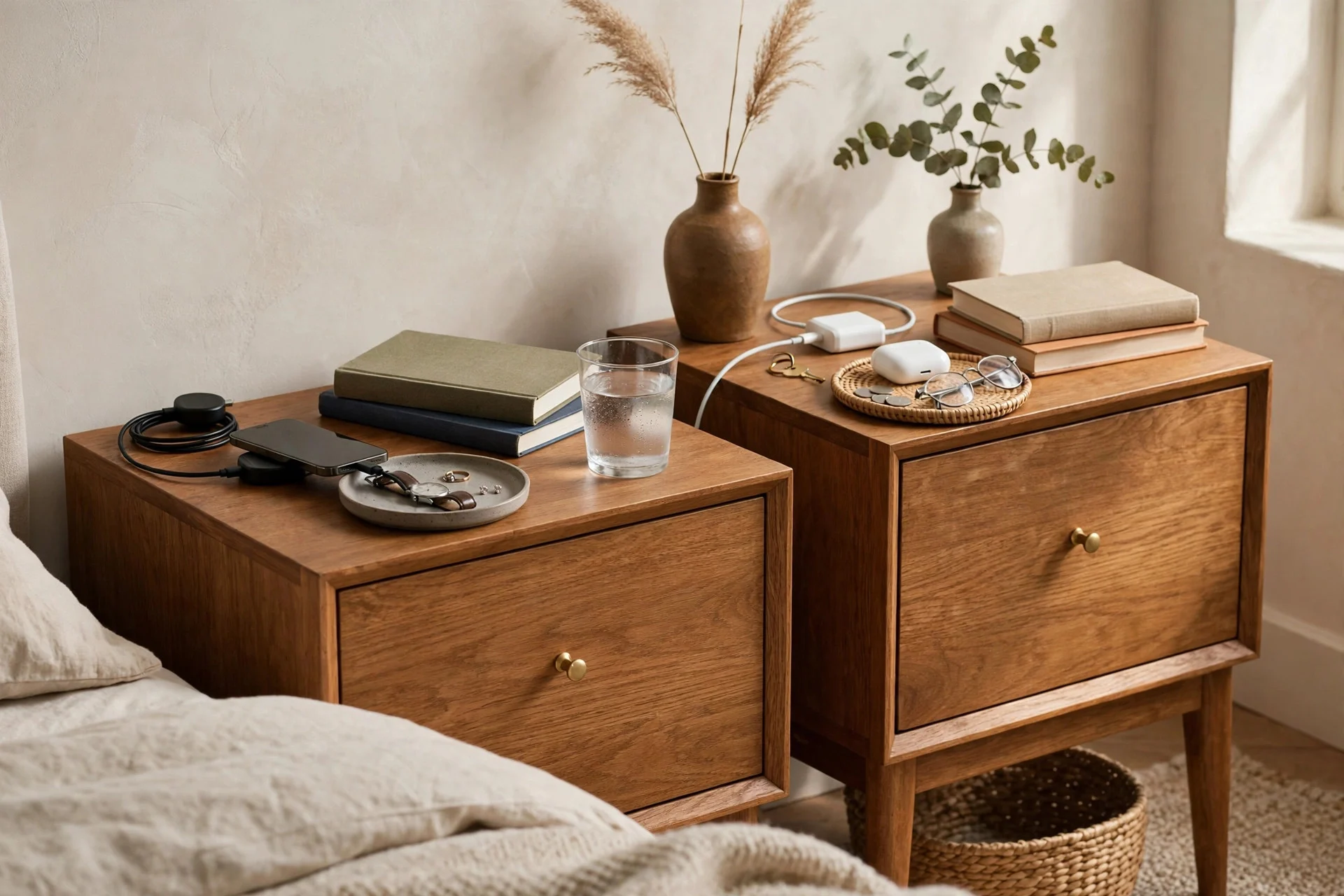
11. Build Separate Bedside Zones With Personal Storage
Separate bedside zones reduce midnight arguments over chargers, books, glasses, and water. Give each partner a nightstand at least 18 inches wide, with a drawer or a small basket for personal items, plus a single charging spot on their own side. A simple nightstand costs $60 to $200, and a small tray or dish for glasses and a watch costs $10 to $25. Keep shared items, like a tissue box or hand cream, in the middle only if both people reach them easily. Avoid one tiny shared nightstand for two people, because clutter builds fast and one person’s items end up on the floor. Tip: run a short charging cable from each side’s outlet, so cables never cross the bed or trail across the other person’s pillow.
12. Plan a Wind-Down Corner for the Night Owl
A wind-down corner gives the partner who stays up later a place to read, stretch, or listen to a podcast without sitting upright in bed next to a sleeping partner. A comfortable chair, a small side table, and a soft lamp in a bedroom corner need about 30 by 30 inches of floor space. A reading chair costs $150 to $400, and a floor lamp with warm light costs $40 to $90. Keep the corner away from the bed’s headboard side if possible, so light and movement stay out of the sleeper’s line of sight. Avoid a bright desk setup in the bedroom, because work light and screens make it harder for both people to wind down. Tip: set a firm move-to-bed time for the night owl, even if sleep comes later, so the sleeping partner is not disturbed by repeated trips in and out.

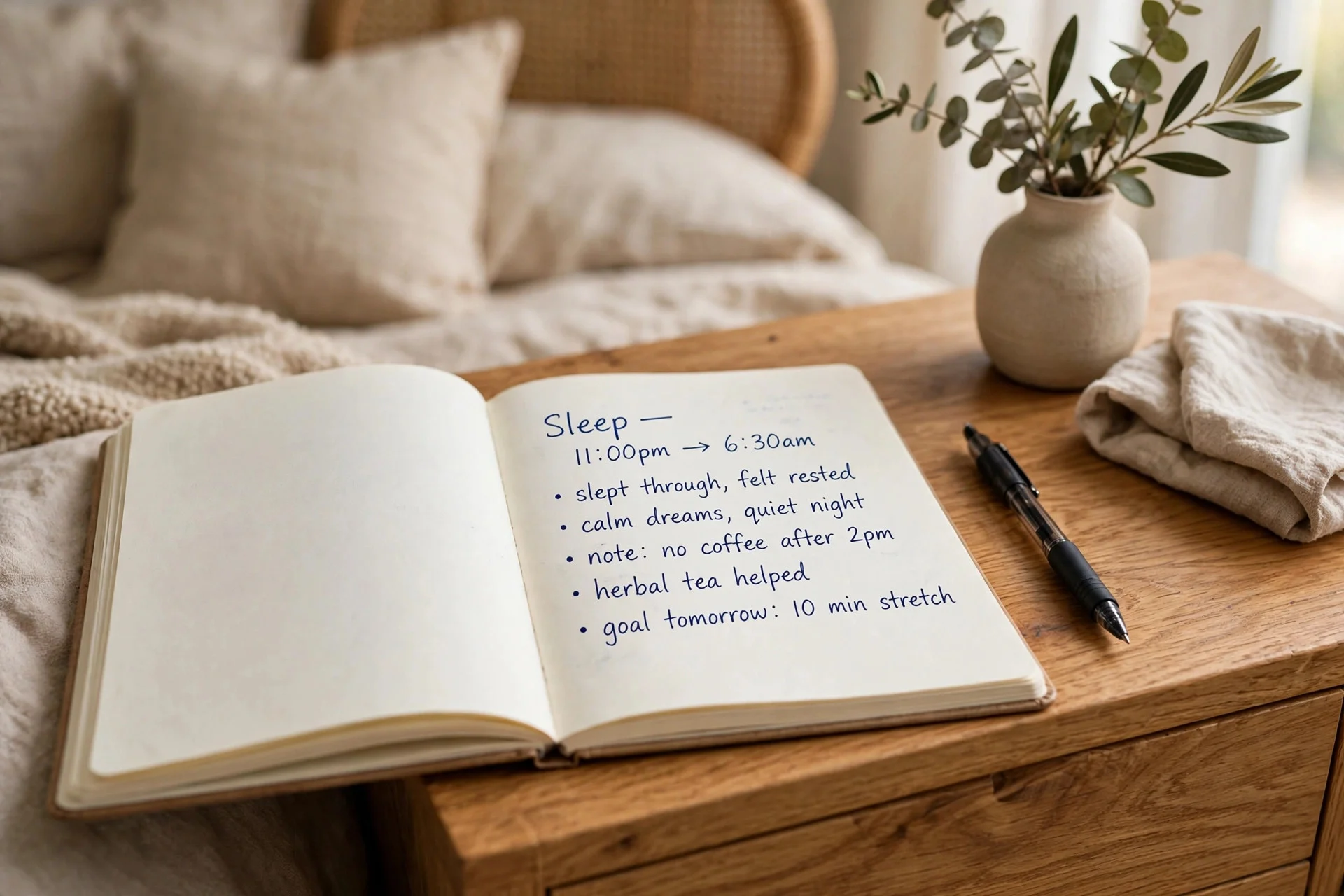
13. Use a Bedtime Routine Chart for the First Two Weeks
A short written routine helps couples test changes instead of arguing about them from memory. For two weeks, note bedtime, wake time, room temperature, bedding layers, and a simple sleep score from 1 to 5 for each person. A notebook on the nightstand costs nothing, or use a free notes app with one shared note. Review the notes together on Sunday, keep what helped, and drop what did not. The goal is data, not blame, so keep entries short and factual. Avoid changing five things at once, because you will not know which change helped when sleep improves. Tip: change one item per week after the first test, such as pillow height first, then duvet weight, so each result stays clear.
14. Layer Sheer and Blackout Curtains for Flexible Light Control
Layered curtains give couples flexible light control across seasons and schedules. Hang a sheer panel closest to the glass for daytime privacy and soft light, and a blackout panel on the outer rod or track for sleep. A double rod setup costs $30 to $80, plus $25 to $70 per blackout panel and $15 to $40 per sheer panel for a standard 48-inch-wide window. Close only the blackout side over the late sleeper’s window section if you use two separate panels. Avoid single heavy drapes that block all light but also block airflow and make the room feel closed during the day. Tip: leave the sheer closed during the day and open the blackout fully in the morning, so the room gets daylight while the sleeping partner still has a dark zone.

15. Design a Middle Zone That Keeps the Bed Feeling Shared
Split bedding and split bases can make a bed feel like two separate beds, so a shared middle zone matters. A long lumbar pillow across the centre, a shared throw folded at the foot, and matching bedside lamps keep the bed looking and feeling like one space. A lumbar pillow 36 to 54 inches long costs $30 to $70, and a cotton throw costs $30 to $80. Agree on a middle ground for room temperature and light, then use personal layers and lights for the rest. Avoid pushing two twin beds far apart with a visible gap and no shared dressing, because the room can start to feel divided. Tip: make the bed together each morning with the shared throw in place, since that small daily habit keeps the shared feel even when sleep setups differ.

FAQ
How do couples with different sleep styles share a bed without waking each other?
Start with motion control and separate covers. A pocketed-coil or foam mattress, two duvets, and separate pillows cut most night-time disturbance. Add a white noise machine and a narrow reading light if noise or light is the main issue, and test one change at a time.
What is the best mattress setup for bedroom ideas for couples with different firmness needs?
A split king with two twin XL mattresses works best when firmness needs differ a lot, since each side can be soft or firm on its own. If your room cannot fit a king, a split-top queen or a medium-firm hybrid with a topper on one side is a practical second choice.
Can different sleep schedules work in the same bedroom?
Yes, with clear zones and quiet habits. Use a vibrating alarm for the early riser, blackout cover on the late sleeper’s side, and a wind-down corner for the partner who stays up later. Agree on lights-out and wake-up rules in advance, so neither person has to guess each night.
Conclusion
Good bedroom ideas for couples are less about one perfect product and more about giving two people fair control over their own sleep. A split mattress, two duvets, separate lights, and a clear plan for sound and morning alarms can remove most of the friction that builds up night after night. Start with the change that matches your biggest problem, whether that is heat, movement, light, or different schedules. Test it for two weeks, keep notes, and adjust one thing at a time. The goal is not a showroom bed. It is a room where both partners wake up rested, and where different sleep styles stop feeling like a problem to fix.