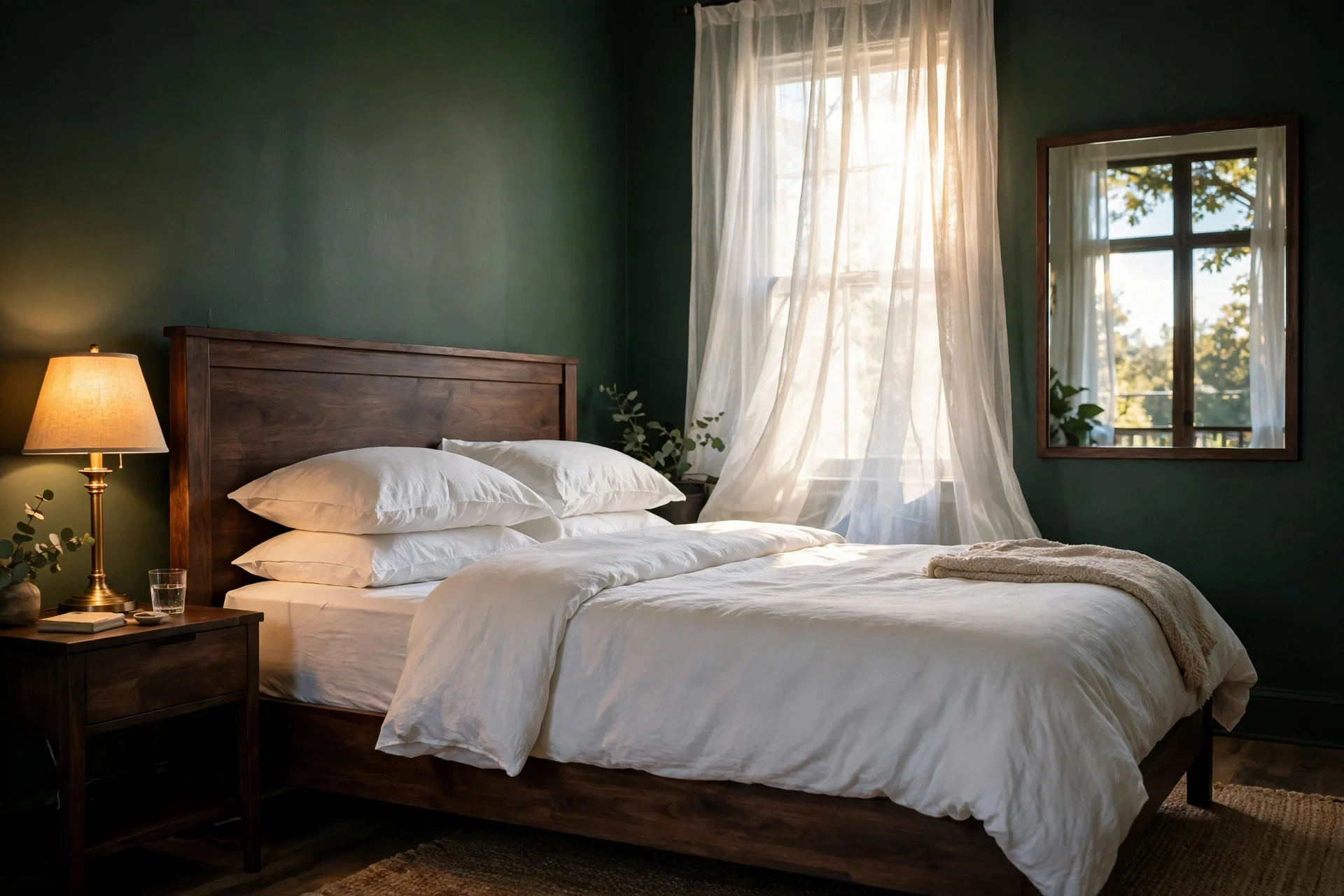
A dark bedroom does not have to feel gloomy when you wake up. The problem is rarely the wall colour on its own — it is flat lighting, heavy curtains, and dark textiles that soak up whatever daylight the window does let in. Fix those, and the same room can feel calm at night and bright at 7 a.m. without repainting the whole place or buying all-new furniture.
The ideas below are practical dark bedroom bright ideas, not a full redesign. Each one covers what to do, what size or cost to aim for, what to avoid, and one tip you can use this week. Start with the lighting and the bedding, since those change how the room feels fastest, then work through the list as far as your budget allows. You do not need to do all fifteen at once. Two or three of the cheapest changes — bedding, curtains, and one extra lamp — will already lift a dark room noticeably, and the rest can follow as your budget allows. What matters is working in the right order: light first, then surfaces that reflect it, then the decoration that makes it feel finished.
1. Layer Three Light Sources Instead of One Ceiling Light
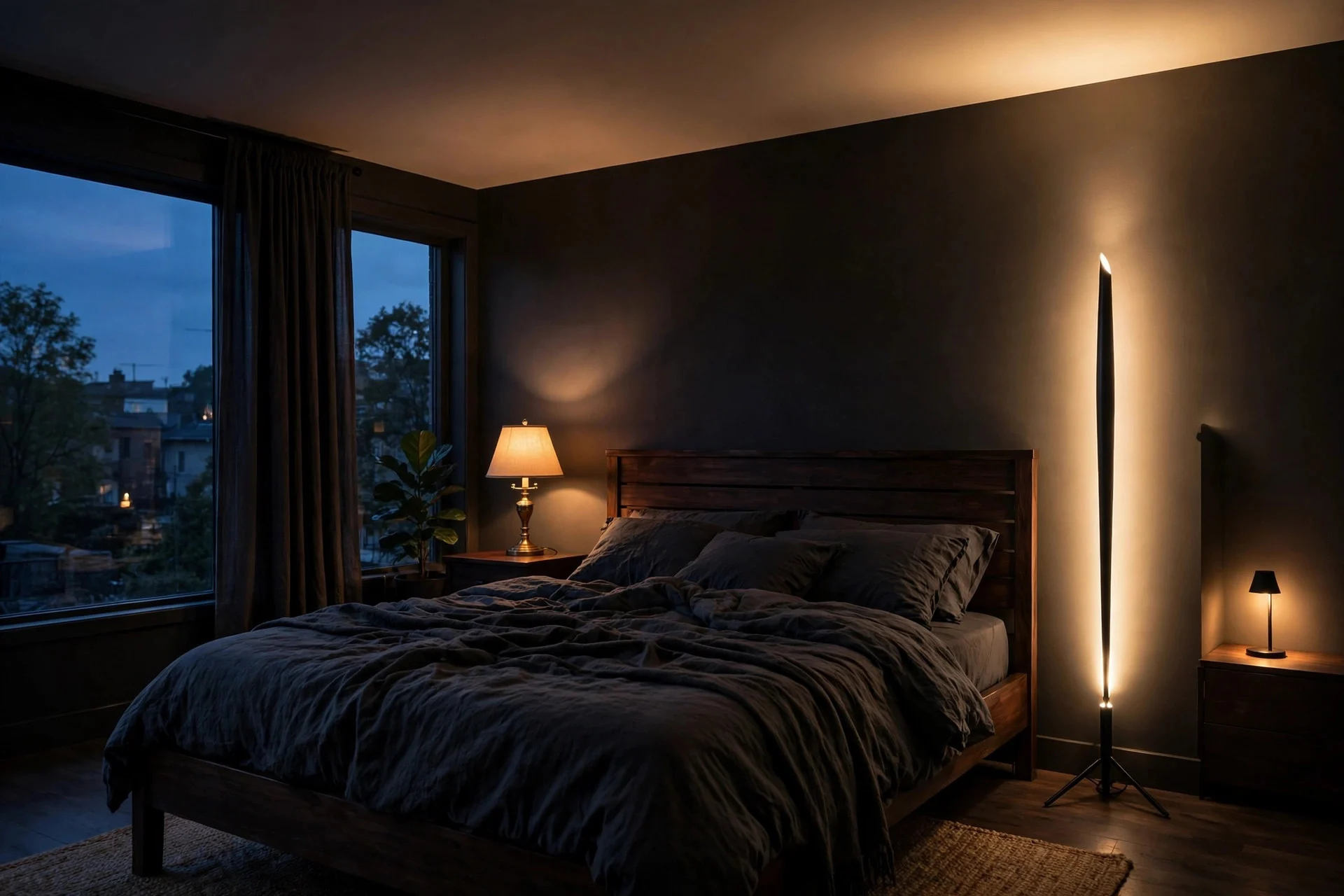
One ceiling light in a dark bedroom throws hard shadows and leaves the corners black. Layer three light sources instead: a bedside lamp for reading, a floor uplighter or tall lamp for general glow, and one small accent light for the corners. A bedside lamp with a warm bulb covers the bed, a floor lamp with an upward shade bounces light off the ceiling, and a small plug-in light or LED strip fills the last dark corner. That spread is the core of dark bedroom bright ideas — light from three heights feels natural at night and can be switched to a bright daytime setting in the morning. A table lamp costs $25 to $70, a floor uplighter $40 to $120, and an accent light $15 to $40. Avoid a single bare ceiling bulb above 4000K, which makes dark walls look flat and grey. Tip: put all three on dimmers or smart plugs so one switch gives you a bright morning setup. Place the uplighter in the corner furthest from the window, since that is usually the darkest one.
2. Switch to Light-Coloured Bedding That Bounces Light Back
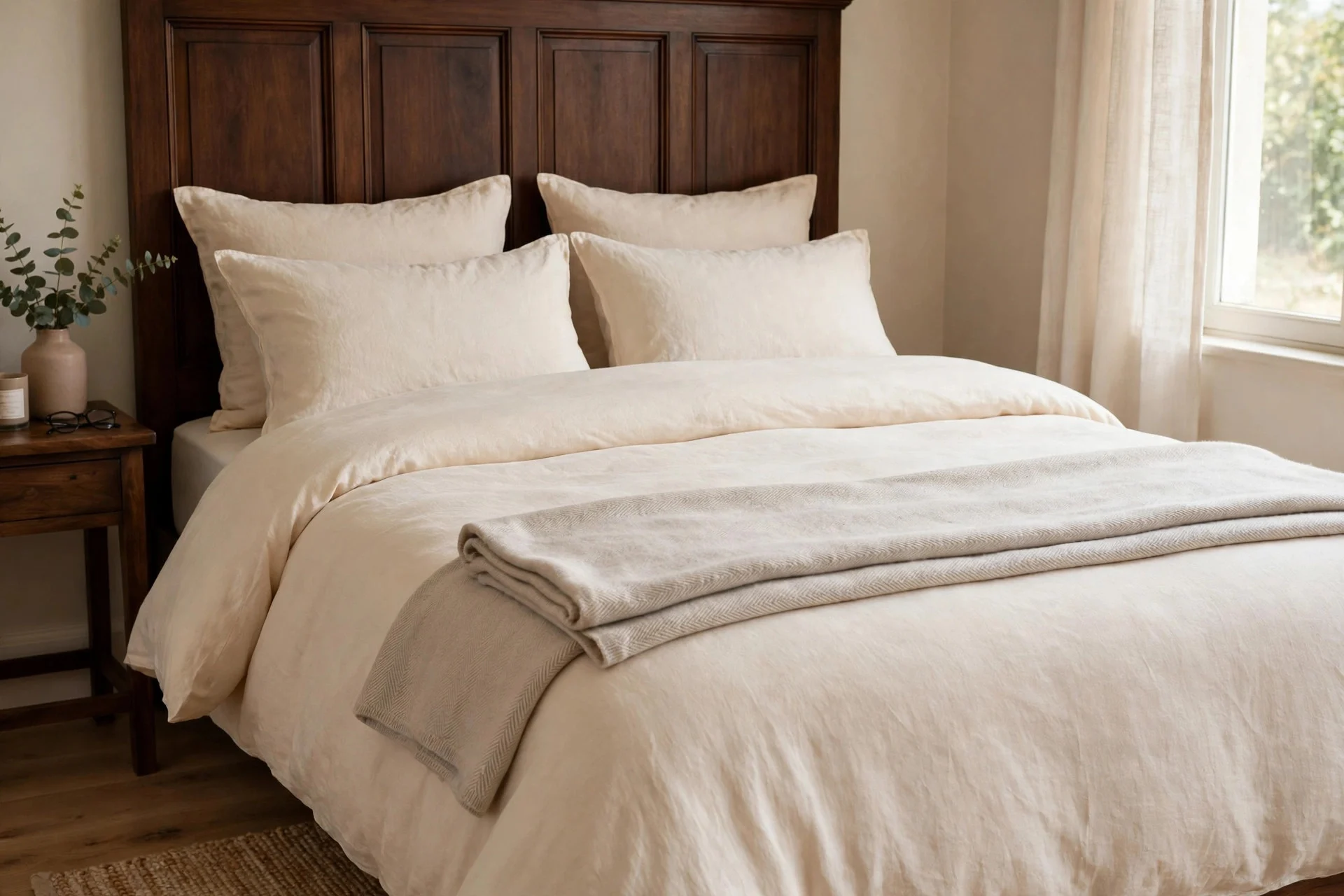
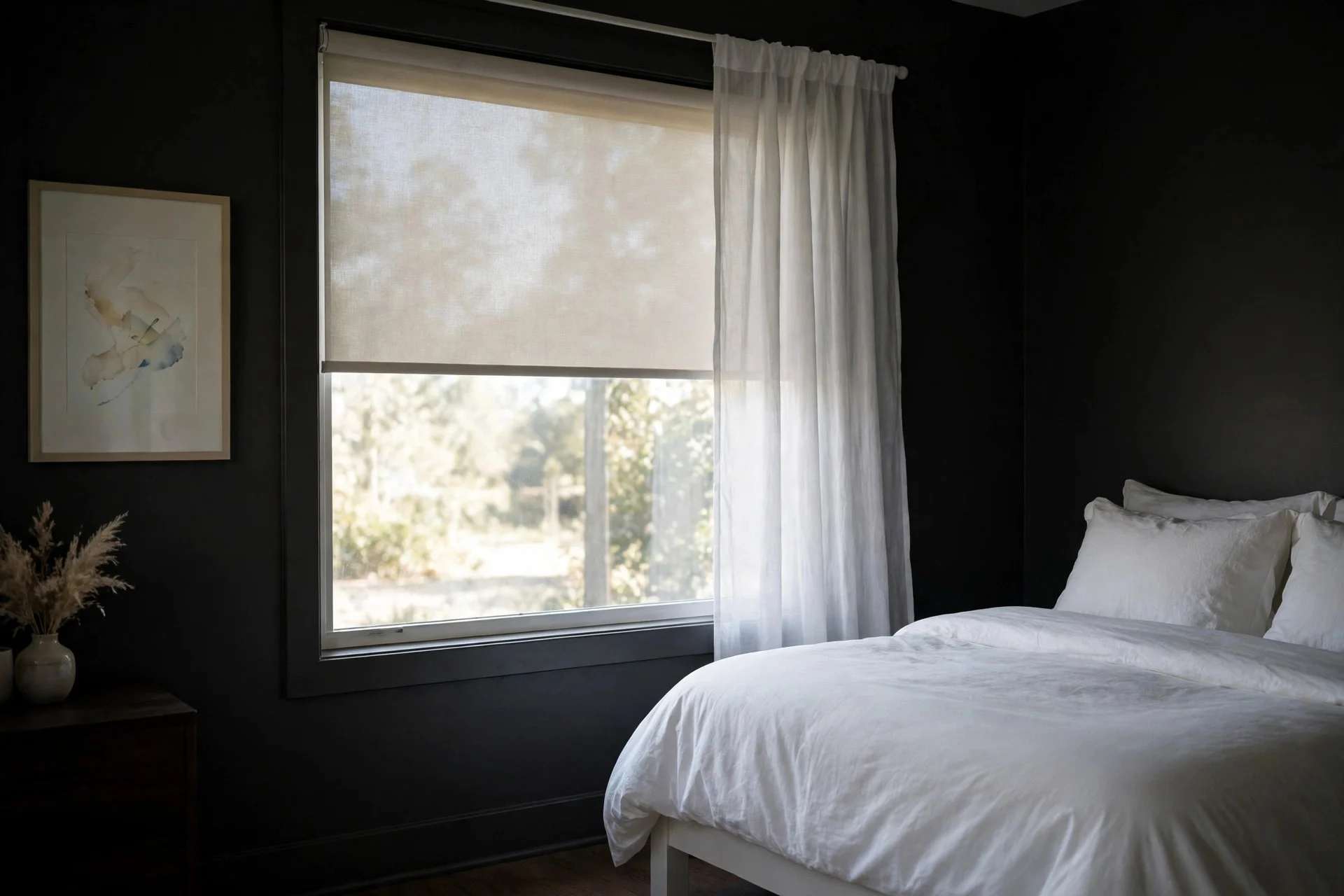
Dark bedding absorbs light. Light-coloured bedding — warm whites, creams, pale greige, soft stone — reflects it back into the room, which is why it is the cheapest brightening change you can make. Keep the duvet and sheets in that light family and let the dark headboard or frame stay as the contrast. A queen duvet set in cotton or linen-look fabric costs around $60 to $180, and a set of crisp white pillowcases runs $20 to $45. Avoid charcoal, black, or deep navy bedding in a room that already runs dark, and avoid shiny satin, which shows every wrinkle. Wash new bedding before first use so it softens and sits flatter. Tip: fold a cream or pale greige throw across the foot of the bed — it brightens the exact spot your eye lands on first when you walk in. If your duvet cover is dark but you are not ready to replace it, a light top sheet folded back over it gives you the same bright surface for a fraction of the cost.
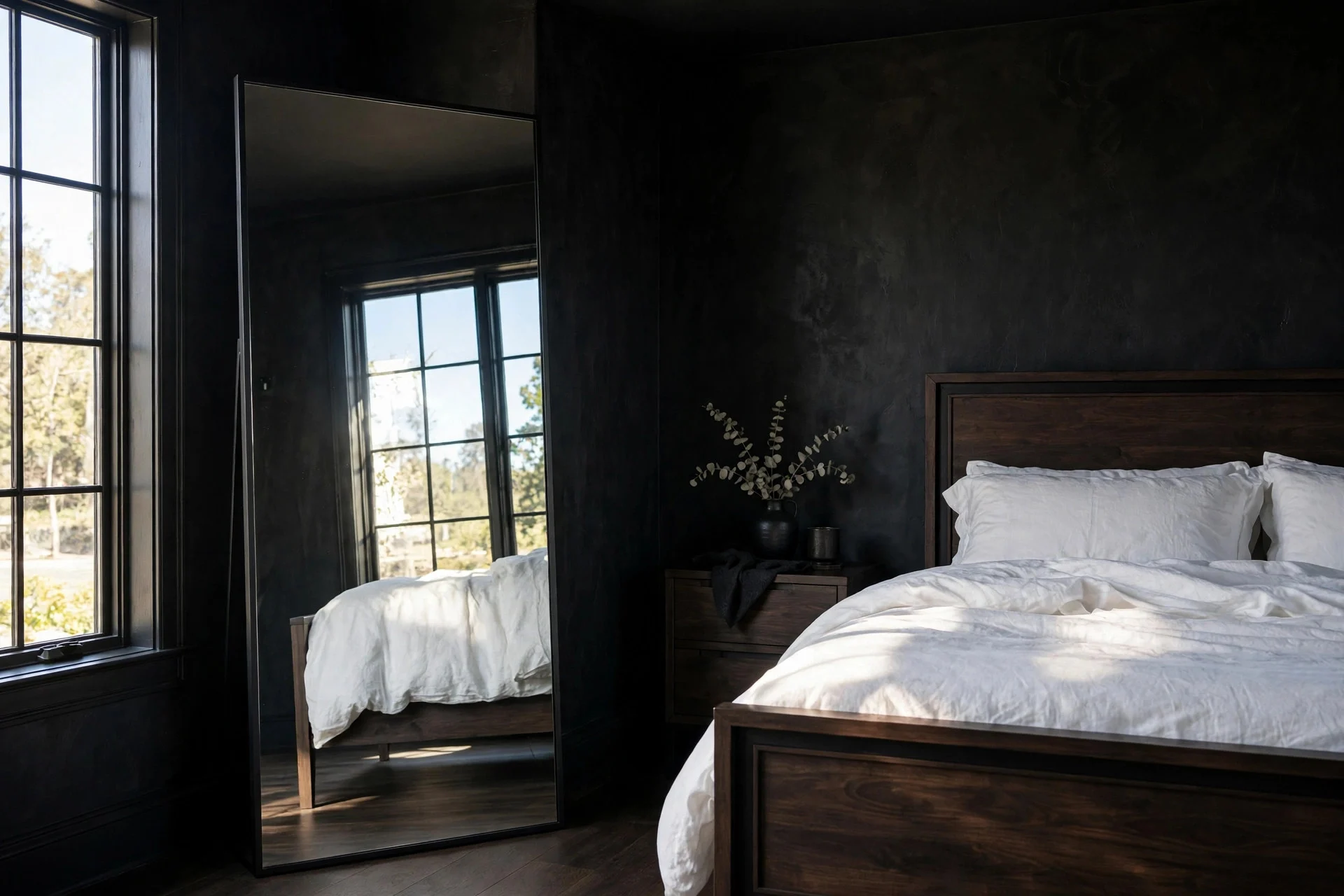
3. Hang a Mirror Opposite the Window
A mirror opposite the window is the fastest way to spread daylight through a dark bedroom. It catches the window light and throws it back across the room, so the side of the bed that never sees sun gets a second source. Place it so it reflects the window, not the bed — the aim is light, not a view of yourself at night. A full-length mirror 120 to 150 cm tall suits most bedrooms, and a wide wall mirror 90 to 120 cm across works above a dresser. Expect around $60 to $200 for a framed full-length mirror and $40 to $120 for a wide wall mirror. Avoid hanging it where it reflects a bright hallway light into your eyes at night. Tip: use a mirror with a slim light wood or brushed gold frame so it brightens the wall as well as the reflection. Fix it with two wall anchors rated well above its weight, and check the reflection from the bed before you drill, so you are not staring into it at night.
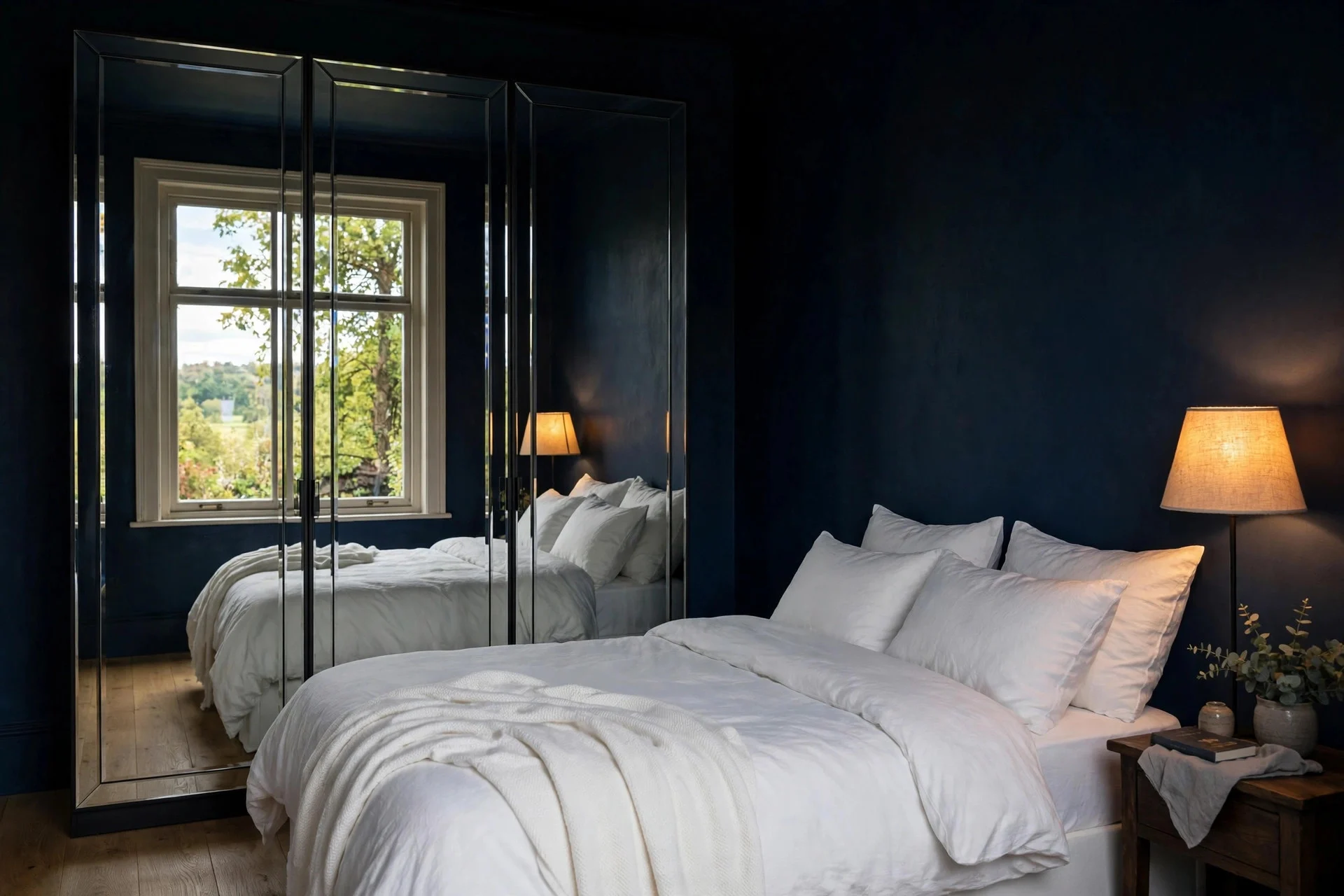
4. Fit Mirrored Wardrobe Doors in a Dark Room
If your wardrobe doors are dark wood or matte black, mirrored wardrobe doors do the same job as a wall mirror but over a bigger surface. They bounce daylight across the whole room and make a small dark bedroom feel wider, which helps in the morning when you are getting dressed. You do not need to replace the wardrobe — adhesive mirror panels or door-mounted mirror tiles cost around $50 to $150 for a pair of doors, while a full mirrored sliding door set runs $300 to $700. Avoid cheap stick-on mirror film on a textured door, since it bubbles and distorts. Keep the mirror clean with a damp microfibre cloth, because fingerprints kill the reflection fast. Tip: mirror only the doors that face the window, and leave one plain door, so the room does not feel like a hall of mirrors. Measure the doors before you order panels, and leave a 2 mm gap between panels so they do not chip when the doors move.
5. Swap Heavy Curtains for Sheer Curtains
Heavy lined curtains in a dark bedroom block the morning light you actually want. Sheer curtains filter daylight instead of stopping it, so the room wakes up with the sun while still giving you privacy from the street. Hang them from a rod 10 to 15 cm above the window frame and 10 to 20 cm wider on each side so they stack off the glass. For a standard 150 cm window, a pair of sheer panels costs around $40 to $120. Avoid thick blackout fabric as the only layer if your goal is a bright morning — keep a lighter roller blind behind if you need darkness to sleep. Wash sheers every few months, since dust dulls the light they let through. Tip: choose a warm white or ivory sheer rather than pure blue-white, which can make a dark room look colder. If the window faces a neighbour, double the sheer panels on the rod so privacy improves without losing much daylight.

6. Use Daylight-Mimicking LED Bulbs at 3000–3500K
The bulb matters as much as the lamp. Daylight-mimicking LED bulbs in the 3000 to 3500K range give a clear, warm daylight feel that suits a dark bedroom in the morning without the cold glare of a 5000K or 6500K bulb. Use them in the bedside lamp and uplighter, and keep a dimmer so you can drop to a softer 2700K glow at night. A pack of colour-adjustable LED bulbs costs around $15 to $40, and dimmable smart bulbs run $10 to $25 each. Avoid a single fixed cool-white bulb in the ceiling fitting, which flattens dark walls and makes skin look tired. Check the bulb fits your shade — a large globe in a small shade overheats. Tip: set smart bulbs to come on at 3000K twenty minutes before your alarm so the room is already bright when you wake. Keep one spare bulb of the same type in a drawer, since a mismatched replacement in one lamp makes the layers look uneven.
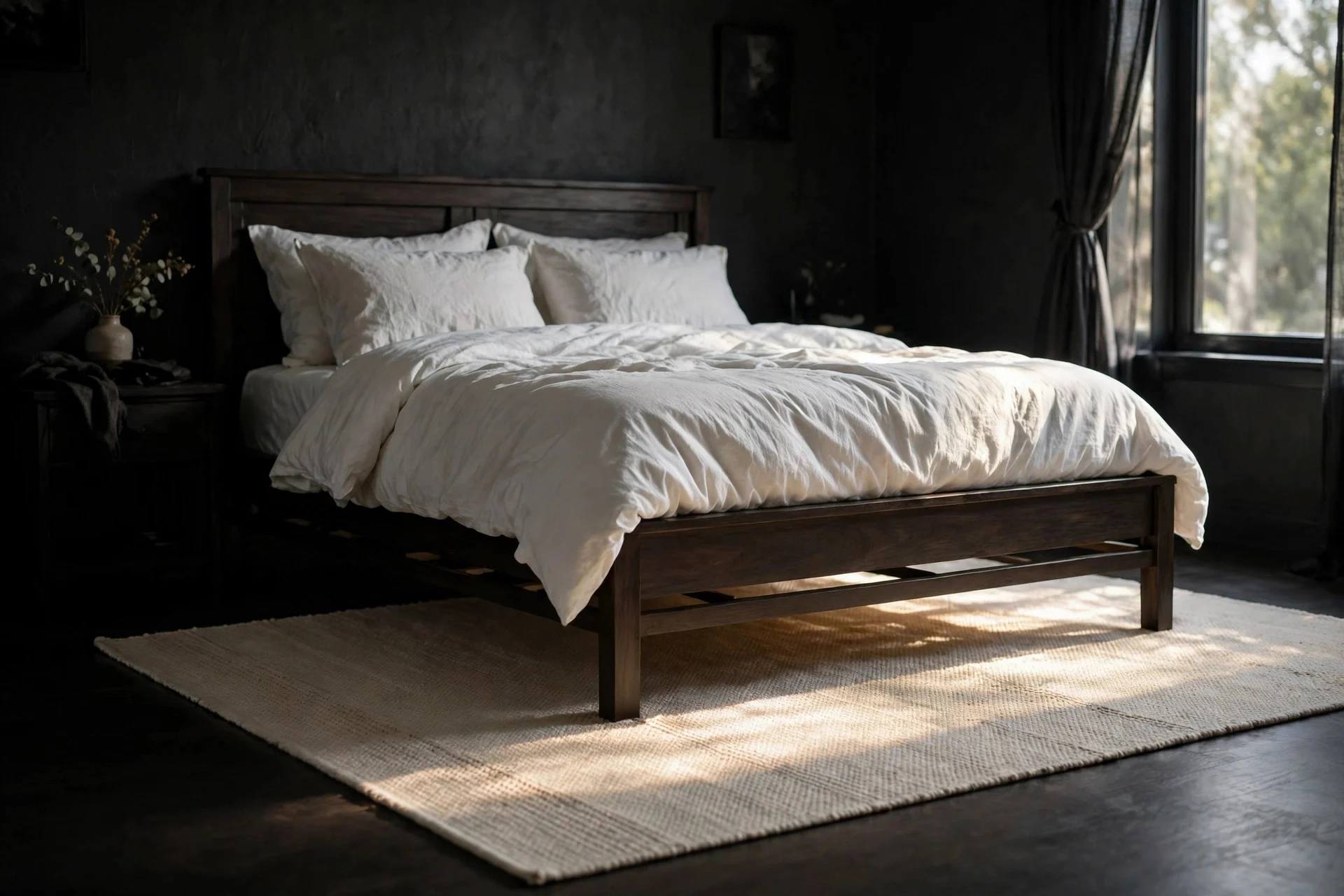
7. Add a Cream Rug to Bounce Light Off the Floor
Dark carpet or dark wood floors absorb light from above. A cream rug under or beside the bed reflects it back up, which brightens the lower half of the room where it usually feels heaviest. Pick a flat-weave or low-pile rug in cream, ivory, or pale greige, roughly 160 by 230 cm under a queen bed or 60 by 120 cm on each side. A good cream flat-weave costs around $120 to $350, with smaller bedside runners at $40 to $90 each. Avoid a thick shaggy cream rug in a dark bedroom, since it traps dust and flattens the light. Add a thin non-slip pad so the rug does not slide on wood at night. Tip: let the rug extend 60 cm past each side of the bed so your feet land on light colour first thing in the morning. A cream rug also softens the sound of the room, which helps a dark bedroom feel calmer as well as brighter.
8. Swap Solid Nightstands for Glass Nightstands
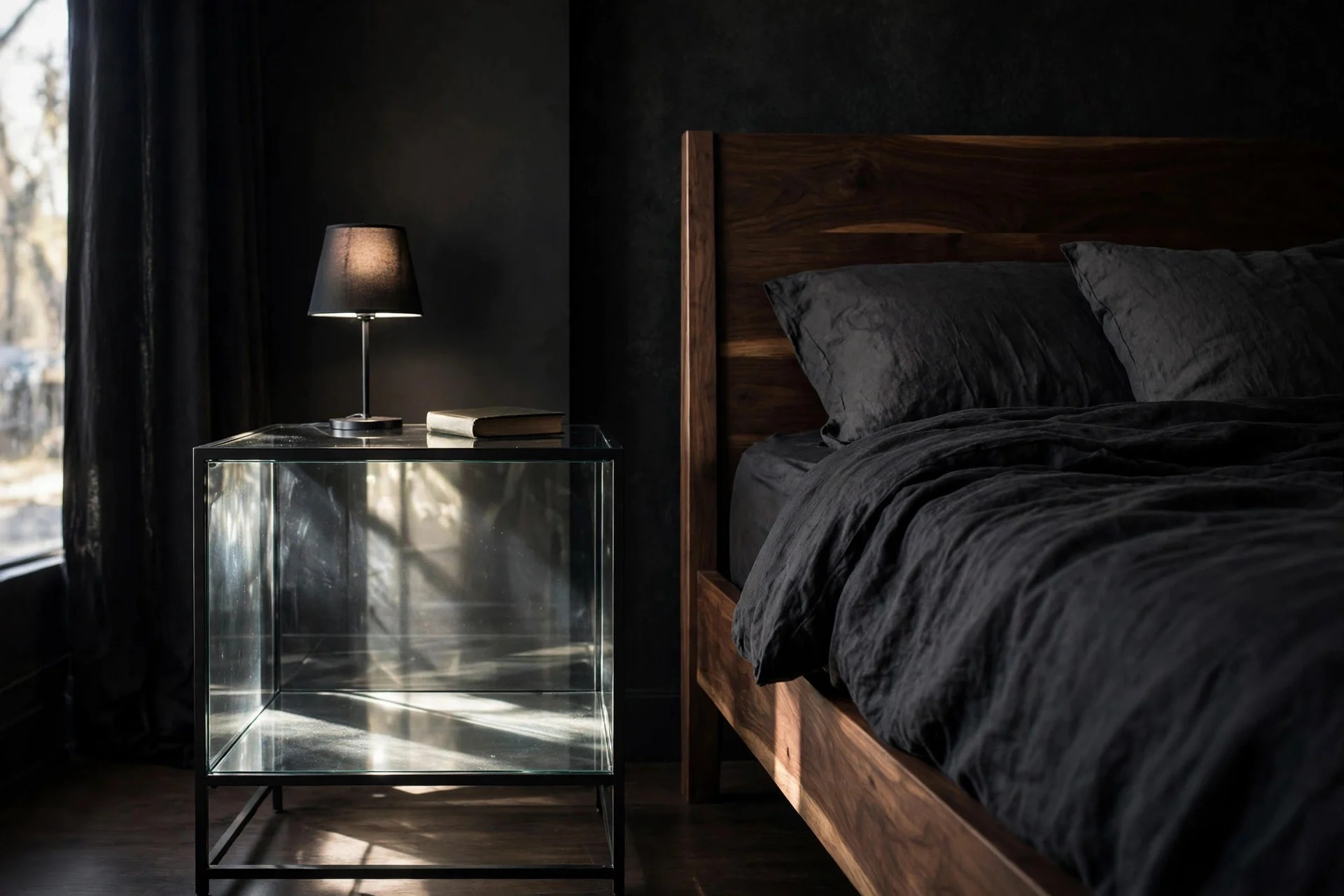
Solid dark nightstands block light and add visual weight next to the bed. Glass nightstands let light pass through and keep the floor line visible, so the bedside area feels open instead of boxed in. A glass-top nightstand with a slim metal or light wood frame, around 40 to 50 cm wide and 55 to 65 cm tall, suits most beds. Expect around $80 to $220 each, depending on frame and glass thickness. Avoid very thin glass without a tempered rating, since it chips easily at the edges. Keep a small tray on top for a lamp and phone so the glass does not look bare. Tip: a glass nightstand with a lower glass shelf gives you storage without the solid block of a drawer unit. Wipe glass tops with a damp cloth and dry them straight away, since water marks show up fast under a lamp.
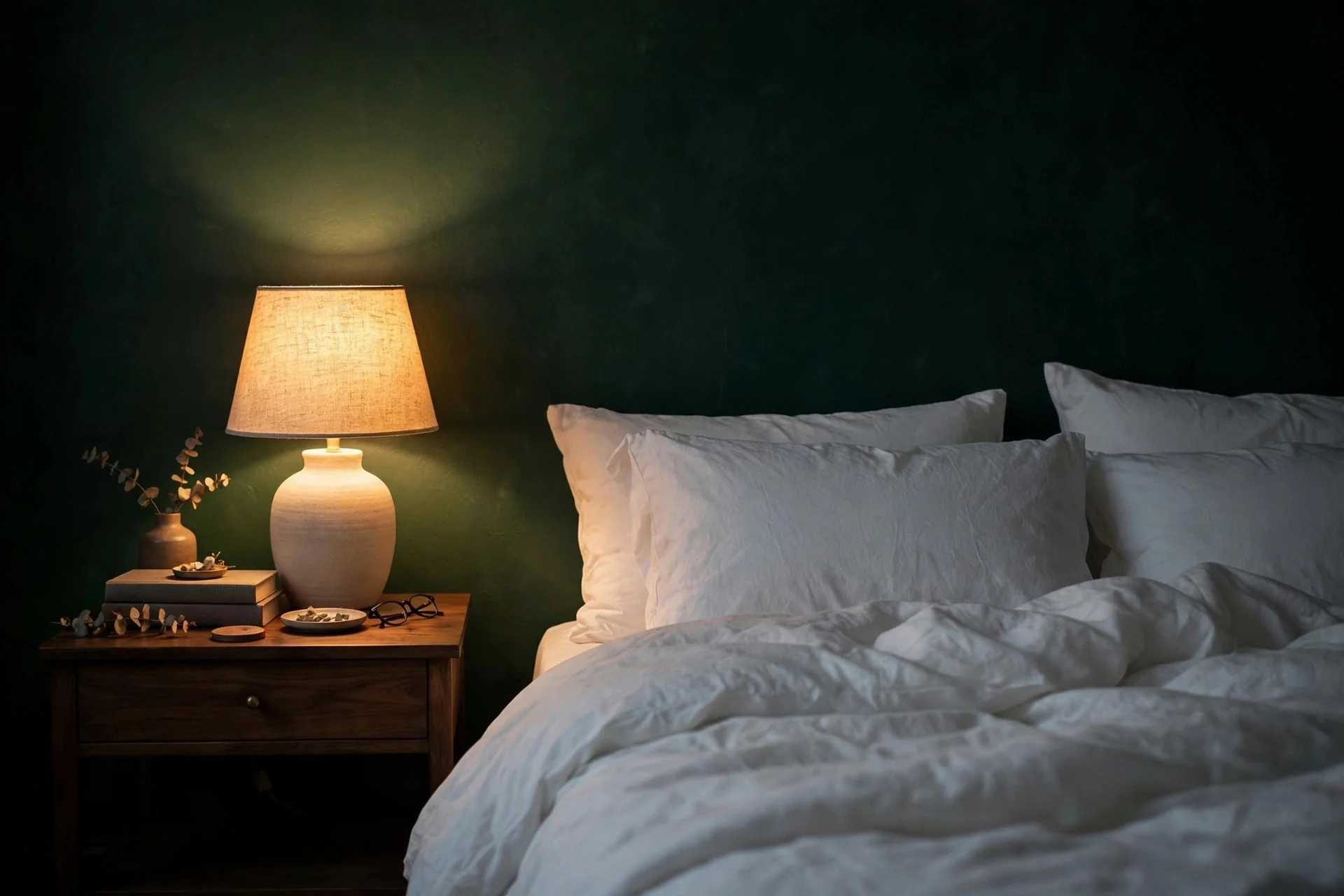
9. Bring in a Gold or Brass Table Lamp
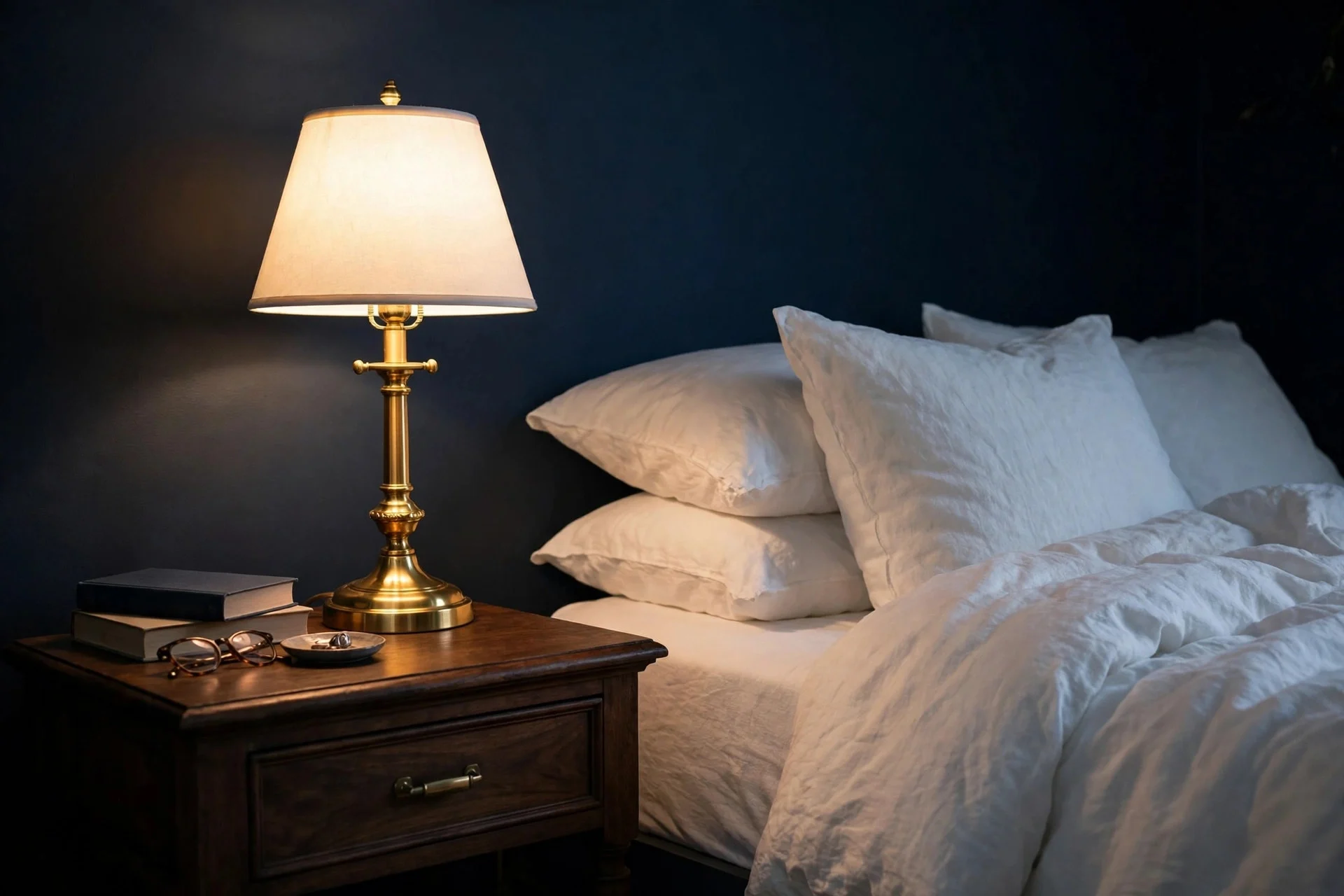
Dark furniture reads heavy until something warm and reflective breaks it up. A gold or brass table lamp does that job — the metal catches lamp light and daylight and throws a warm glow across dark wood. Choose a lamp 35 to 45 cm tall with a cream or white shade, around $35 to $100, and pair it with a 3000K bulb from Idea 6. Avoid bright polished gold everywhere — one lamp per side is enough, and match the finish to your mirror frame or drawer pulls. A brass lamp also suits a dark green or navy wall, since the warm metal lifts the colour instead of fighting it. Tip: a gold lamp with a white linen shade looks brighter than one with a dark shade, which swallows its own light. If you already own a dark lamp, a new light shade alone can lift it without replacing the base.
10. Repaint With Warm Neutral Walls in a Luminous Sheen
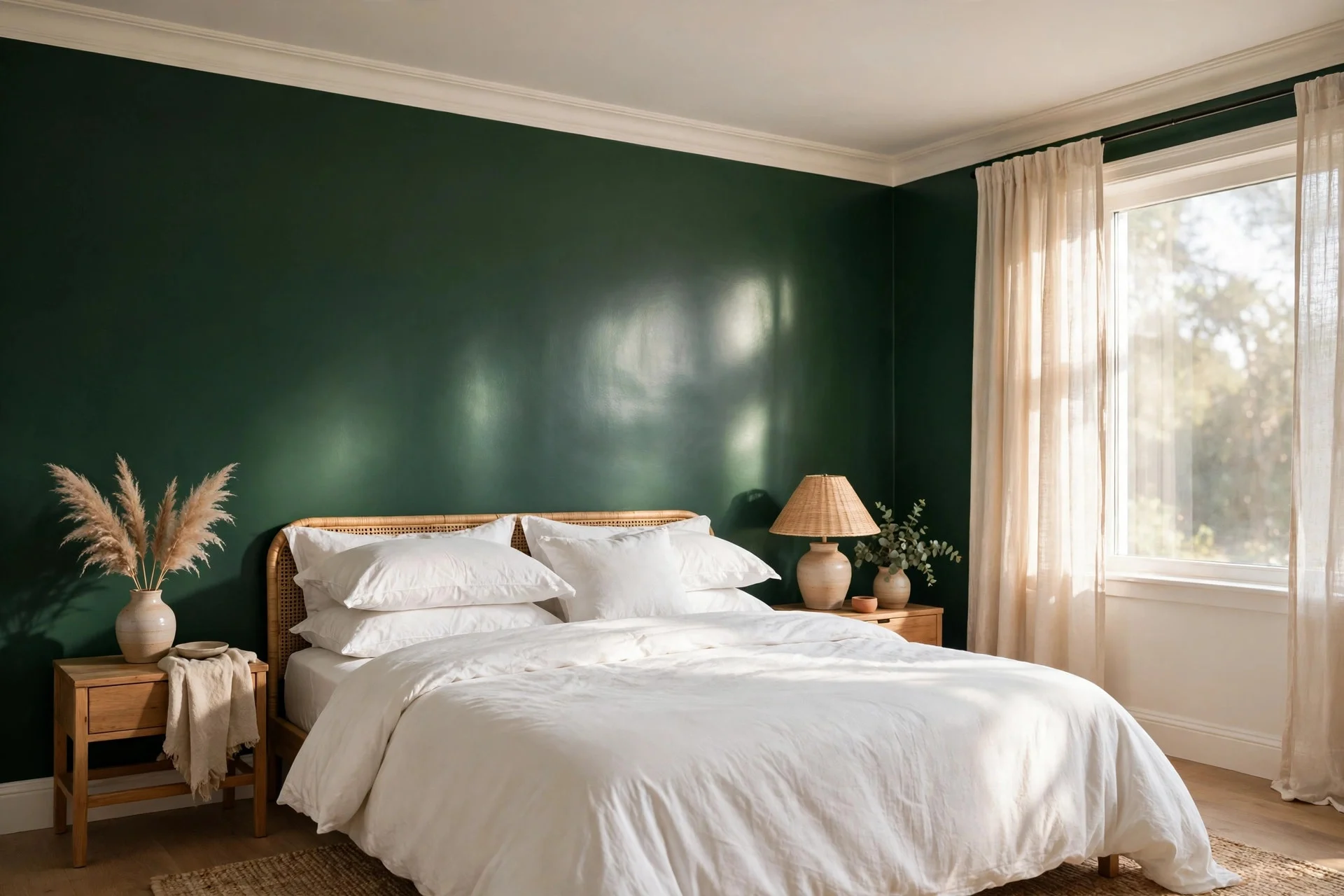
If you do repaint, warm neutral wall colours keep a dark bedroom calm without making it dull. Deep green, navy, and charcoal all work in a dark room when they are finished with a luminous sheen — a soft eggshell or satin that catches light instead of a flat matte that absorbs it. Paint the walls in the deep tone and keep the ceiling and trim in warm white so the top of the room stays light. One bedroom costs around $50 to $120 in paint plus rollers and tape. Avoid flat matte paint in a deep colour, which makes the room feel smaller and shows scuffs. Test a sample patch where morning light hits it, since deep colours shift a lot through the day. Tip: paint the wall behind the bed in the deep tone and the other walls one shade lighter for depth without darkness. Stir the tin well and do two thin coats rather than one thick one, since deep colours streak easily and show every brush mark in lamplight.
11. Keep the Dark Furniture and Brighten the Textiles
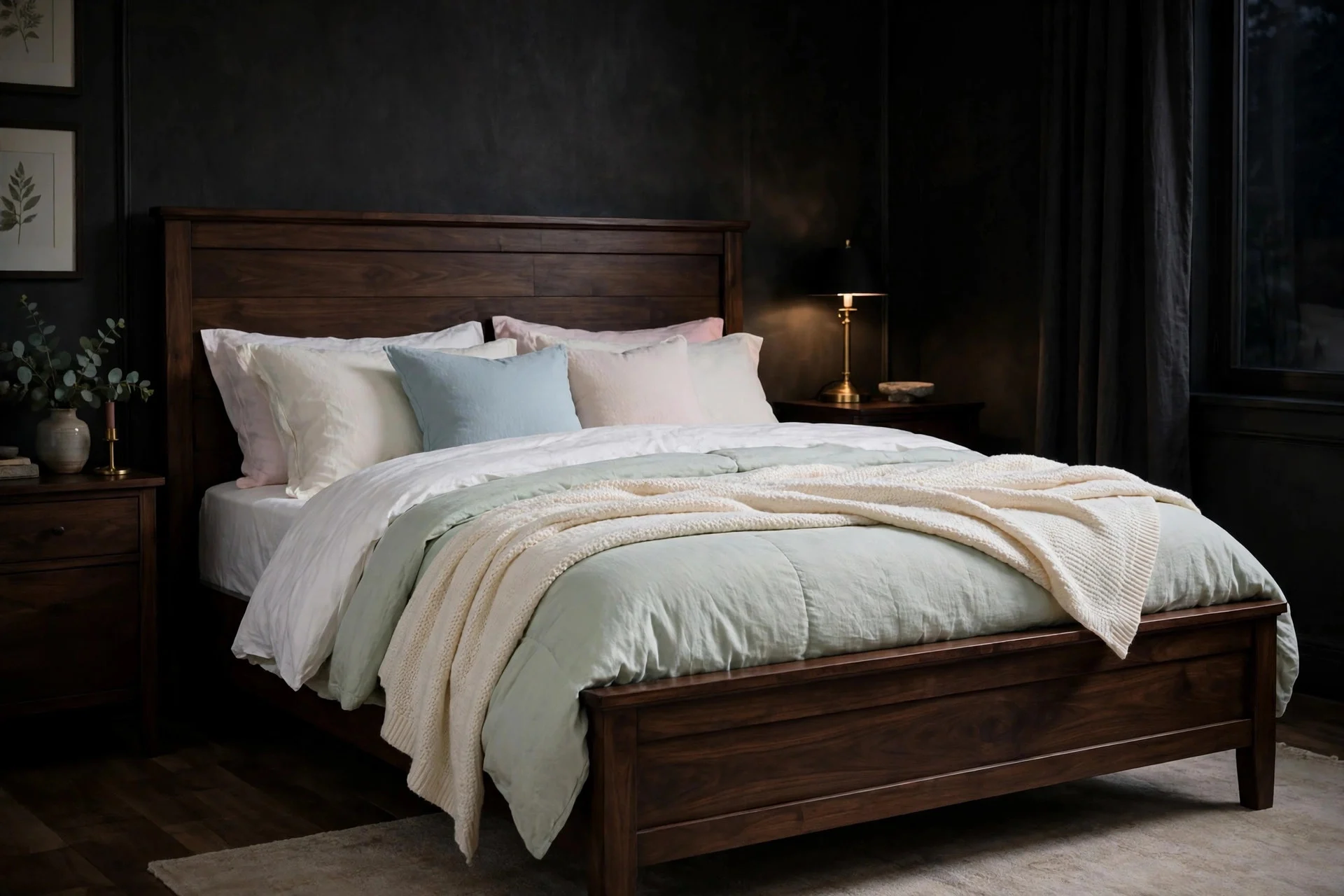
You do not have to replace a dark wood bed or wardrobe to get a bright bedroom. Keep the dark furniture and brighten everything that touches it: crisp white or pastel bedding, a cream throw, pale cushion covers, and a light bed runner. The contrast is the point — dark wood against crisp white bedding looks intentional, while dark wood against dark bedding just looks dim. A bedding refresh costs around $80 to $220, and new cushion covers run $10 to $25 each. Avoid adding more dark pieces to “match” the furniture, since that deepens the gloom. Keep the textiles in one light family — white, cream, pale greige, soft sage — so the bed reads as one bright block. Tip: start with the duvet cover and pillowcases only, live with it for a week, then decide if you need new curtains or a rug. The same rule works in reverse: if a dark piece of furniture is the only dark thing left, it stops looking like a problem and starts looking like a feature.
12. Paint the Ceiling and Trim Warm White
In a dark bedroom the ceiling is often the darkest surface of all, because it never catches window light. Painting it warm white — and the door frames and skirting to match — creates a light canopy over the room that bounces lamp light back down. It is a small job with a big effect, since layered lighting from Idea 1 needs a light ceiling to bounce off. Ceiling paint for one bedroom costs around $25 to $60, and a tin of warm white trim paint runs $20 to $40. Avoid a pure blue-white ceiling, which can make a dark room look colder at night. Use a low-sheen ceiling paint so marks do not show under the uplighter. Tip: if you rent and cannot paint, a large light-coloured ceiling panel or a white uplighter shade achieves a similar bounce without touching the paintwork. Clean the ceiling light fitting while you are up there, since a dusty shade dims the whole room without you noticing.

13. Lighten the Window Treatment and the Window Wall
Even with sheer curtains, a dark window wall can hold the room back. Lighten the window treatment first — replace dark lined curtains with sheers from Idea 5 — then lighten the wall around the window with a pale frame, a slim mirror, or light-coloured blinds. The window is your main source of morning light, so anything that frames it in dark colour shrinks it visually. A light roller blind costs around $30 to $90, and a slim pale picture frame runs $15 to $40. Avoid a heavy pelmet or valance over the window, which blocks the top of the glass where the most light enters. Keep the curtain rod light in colour too, so it does not draw a dark line across the glass. Tip: hang a small round mirror or light artwork on the wall beside the window to catch and spread the daylight sideways. Keep the windowsill clear of dark boxes and stacks of books, since clutter on the sill cuts the light before it even enters the room.
14. Add Accent Lights in the Dark Corners
Every dark bedroom has at least one corner that never gets light — behind the door, beside the wardrobe, or under a shelf. One small accent light fixes it: a plug-in LED strip under a shelf, a small motion-sensor light inside the wardrobe, or a low uplight behind a plant. Accent lights do not need to be bright; they need to kill the black corner so the room reads as one space. A plug-in LED strip costs around $10 to $30, and a rechargeable wardrobe light runs $15 to $35. Avoid pointing an accent light straight at the bed, since a bright spot at eye level ruins sleep. Warm 2700 to 3000K accent lights suit a dark bedroom better than cool white. Tip: put the wardrobe light on a rechargeable sensor so it comes on when you open the door in the morning. Run the cable for a shelf strip inside a small cable channel so it does not hang across the wall or catch on clothes.

15. Use Light Artwork and Pale Frames on Dark Walls
Dark walls make dark artwork disappear. Light artwork with pale frames — white, cream, light oak, or brushed gold — stands out against deep green, navy, or charcoal and adds another reflective surface to the room. Pick one or two larger pieces rather than a wall of small dark prints, and hang them where lamp light or window light can hit the glass or pale mount. A framed print 60 by 80 cm costs around $40 to $120, and a pair of slim pale frames runs $25 to $60. Avoid black frames with dark prints on a dark wall, which reads as a hole in the wall. Keep the art simple — a botanical line drawing, a landscape, or a light abstract — so it brightens without competing with the bedding. Tip: use glass-fronted frames on the wall opposite the window so the art doubles as a light reflector. Hang artwork at eye level, around 150 to 160 cm from the floor to the centre of the frame.

FAQ
How do I make a dark bedroom feel bright without repainting?
Start with the three changes that cost least: light-coloured bedding in warm whites or creams, sheer curtains instead of heavy lined ones, and layered lighting with a bedside lamp, an uplighter, and one accent light. Add a mirror opposite the window if you have the wall space. Together those bounce and spread the daylight you already have, so the room feels bright in the morning without touching the paint. A cream rug and a lighter lampshade help too, and both are usually cheaper than new furniture.
What colour bedding is best for a dark bedroom?
Warm whites, creams, pale greige, and soft stone bounce the most light back into the room. Crisp white pillowcases against a dark headboard give the strongest contrast, while pastel bedding in soft sage or pale blush keeps the same brightness with a little colour. Avoid charcoal, black, or deep navy bedding in a dark room, since it absorbs light and makes the bed disappear. A light duvet with a slightly darker throw at the foot gives you brightness plus one point of contrast, which keeps the bed from looking flat.
Do mirrors really help a dark bedroom?
Yes, when they are placed to catch window light. A mirror opposite the window or mirrored wardrobe doors reflect daylight across the room and into the corners that never see sun, which makes the whole bedroom feel brighter and larger. The mirror should reflect the window or a light surface, not a dark wall, and a slim light wood or gold frame keeps it bright rather than heavy. Mirrors also help at night, since they spread lamp light the same way they spread daylight.
Conclusion
A dark bedroom feels bright in the morning when light has somewhere to go. Layer three light sources so no corner stays black, bounce daylight with light bedding, a cream rug, and mirrors, and let sheer curtains and 3000 to 3500K bulbs do the morning work. Keep the dark furniture if you like it — brighten the textiles, the lamps, and the frames around it instead. Start with the bedding and the lighting this week, then add the mirror and the rug as you go. Done in that order, the room stays calm at night and wakes up bright, without a full redesign. Keep the changes simple and live with each one for a few days before adding the next, so you can see which ones your room actually needed.