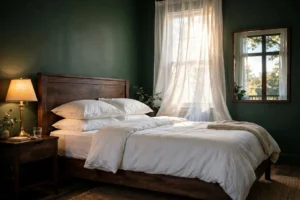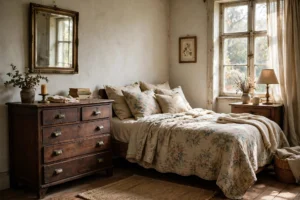
Most master bedrooms have a chair in the corner. It holds clothes, a bag, and a jacket that never made it to the closet. The chair is not the problem. The spot is. A sitting area only gets used when it is comfortable, well lit, and easy to reach without climbing over the bed. That means a chair you can sit in for twenty minutes, a place to set a mug down, and light that works for reading at night.
The ideas below are built around real rooms, from small bedroom sitting areas to larger master suites. Some suit a 10 by 12 foot bedroom with one spare corner. Others need a larger room with space for a small sofa. Each one includes sizes to check, rough costs, and the mistakes that turn a sitting area into a dumping ground. Measure your room first, note the outlets and windows, and start with the idea that matches how you actually spend time in the bedroom: reading, morning coffee, working for an hour, or sitting with your partner before bed.
1. Two Matching Armchairs and a Small Round Table
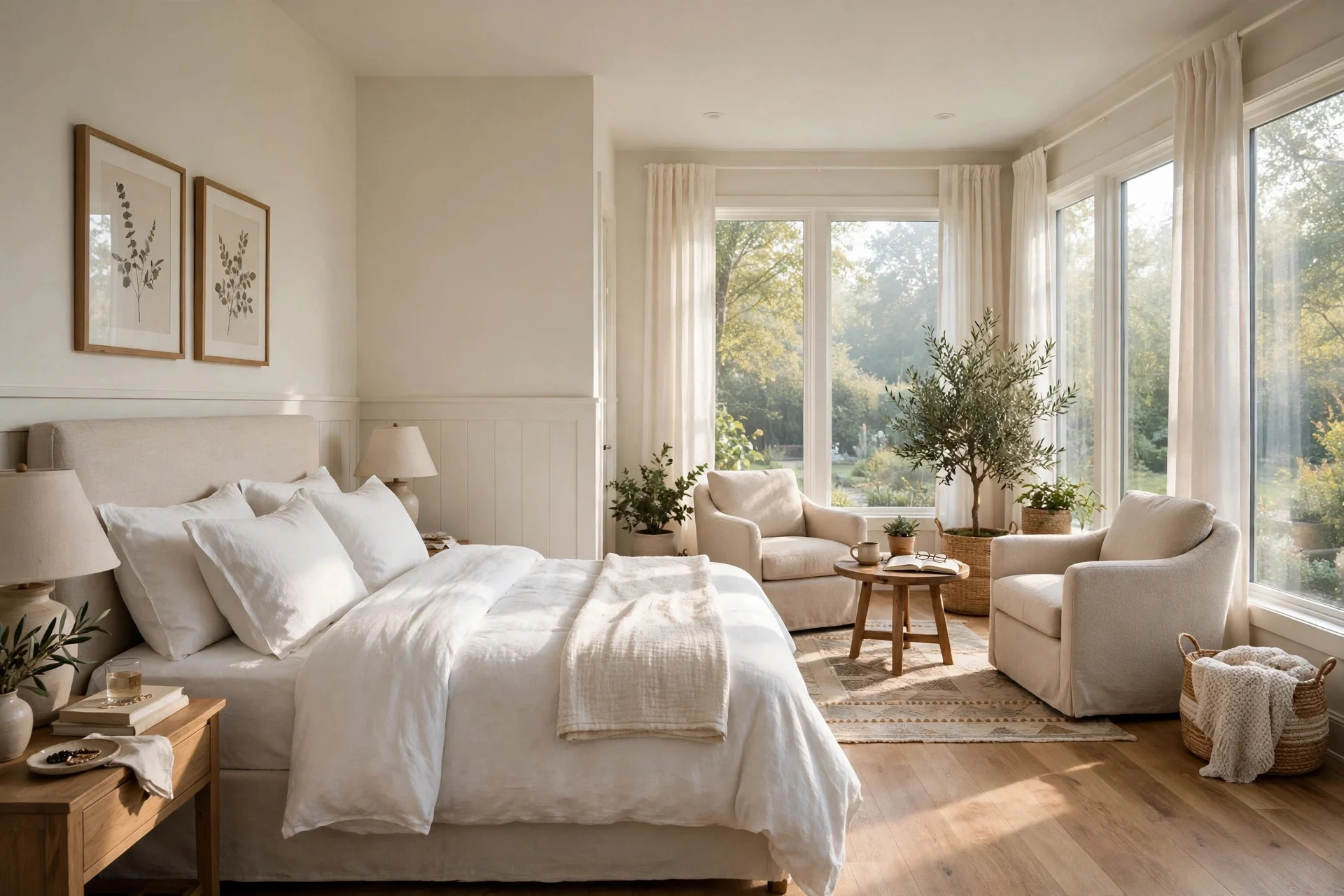
A pair of armchairs with a small table between them is the most-used bedroom seating area layout, because it gives two people a place to sit together. Choose chairs 70 to 80 cm wide with a 45 to 48 cm seat height, so your feet rest flat on the floor. Leave 40 to 50 cm between the chairs for the table and at least 75 cm of walkway behind them. A round table 45 to 55 cm across costs $60 to $200. Avoid chairs too deep or too low — a lounge chair that swallows you makes standing up with a hot mug hard. Tip: angle the chairs slightly toward each other instead of lining them up in a row, so the corner reads as a place to talk.

2. One Good Reading Chair: A Bedroom Reading Nook in the Dead Corner
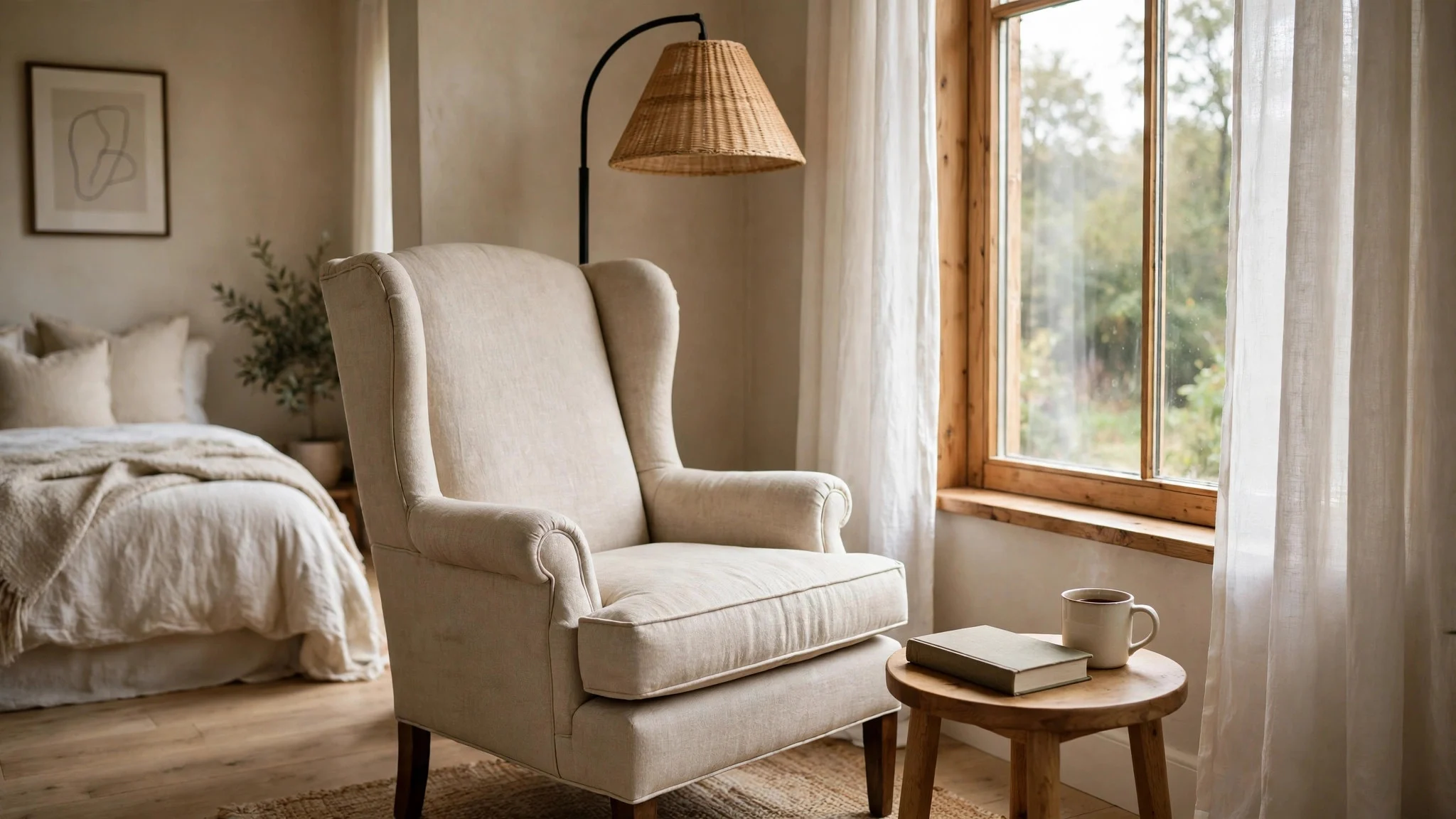
Every bedroom has a dead corner, usually the one by the window or beside the wardrobe, where nothing fits and nothing happens. One well-chosen reading chair turns it into a bedroom reading nook. A wingback or high-back accent chair 75 to 85 cm wide suits most corners. Add a floor lamp behind one shoulder and a small side table within reach for mug and book. Expect $250 to $800 for a decent chair, $60 to $150 for the lamp, and $50 to $120 for the table. Avoid a chair with no table or light nearby — you will stop using it the first time you have nowhere to put your coffee. Tip: sit in the chair in the shop for five full minutes with a book before you buy it — a chair that feels fine for thirty seconds can ache after ten.
3. A Small Loveseat at the Foot of the Bed
A master bedroom loveseat at the foot of the bed gives the room a sitting spot without needing a separate corner. It works best in rooms at least 3.6 metres long, where bed, loveseat, and walkway all fit. Choose a loveseat 120 to 150 cm wide and no deeper than 85 cm, so it does not crowd the bed or block the drawers. Leave 60 to 75 cm between bed and loveseat, enough to walk through and make the bed. A simple upholstered loveseat costs $400 to $1,200; a slipcovered version is worth the extra $100 or so with pets or children. Tip: pick a fabric close in tone to your bedding so the loveseat reads as part of the bed setup, not a piece from the living room.

4. A Window Seat With Storage Underneath
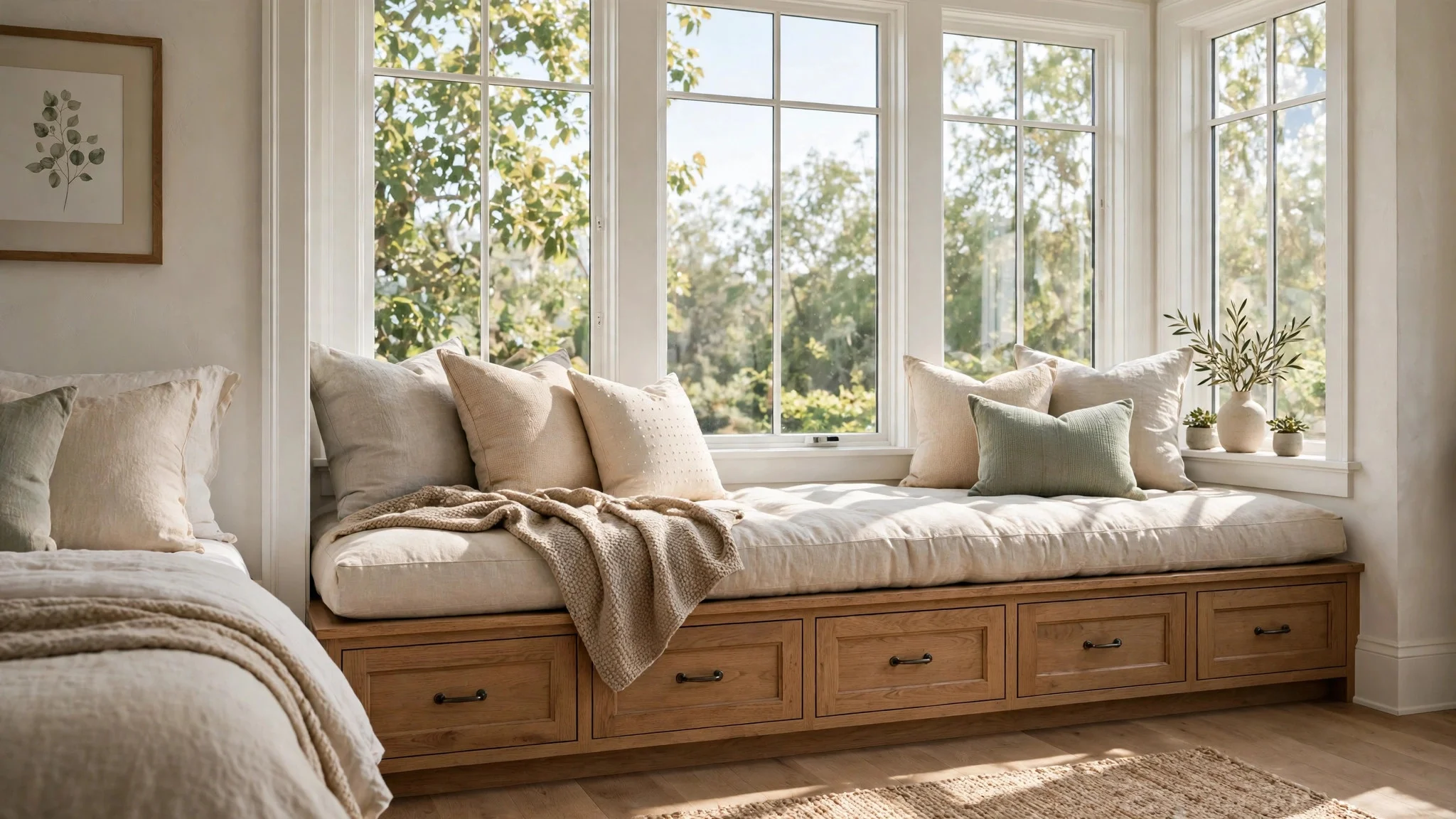
A bedroom window seat turns the brightest spot in the room into the sitting area and adds storage too. A built-in seat 45 to 50 cm deep and high, with a cushion 8 to 10 cm thick, fits most windows. Underneath, hinged lids or deep drawers hold extra bedding, off-season clothes, or shoes. A carpenter-built window seat costs $800 to $2,500 depending on length and finish, while a ready-made storage bench pushed under a low window runs $200 to $600. Keep the cushion in washable fabric — a seat by the window collects dust and sun. Avoid a seat so deep you need a pillow behind your back to sit upright, and never block a radiator or vent under the window.
5. A Desk Nook That Doubles as a Vanity
A desk 100 to 120 cm wide and 50 to 60 cm deep fits a laptop, a lamp, and a notebook; with a mirror above it and a few drawers, it works as a morning vanity. Place it near a window for daylight and near an outlet for a charger. A simple desk costs $150 to $500, a comfortable chair $100 to $300, a wall-mounted mirror $40 to $120. Avoid facing the desk straight at the bed — it makes the room feel like a workspace — and avoid a wheeled desk chair on a thick rug, where it will not roll. Tip: keep a small tray on the desk for keys, a watch, and a phone, so the desk earns its place even on days you never open the laptop.

6. A Coffee Spot on a Small Cart or Tray Table
A coffee or tea spot is the smallest sitting area idea here, and often the most-used. A rolling cart or a tray table 40 to 50 cm wide holds a kettle or a French press, two mugs, and a small jar of tea or coffee. Keep it next to the chairs, not across the room, so you do not have to cross the bedroom with a hot mug. A sturdy cart costs $60 to $180, a tray table $40 to $100, and a small electric kettle $25 to $60. Tip: set the cart up the night before, so the morning routine is pour and sit, not hunting for a clean cup while half asleep.

7. A Rug That Marks the Sitting Zone
A rug turns two chairs in a corner into a real sitting area; without it, the chairs look like furniture waiting to be moved. With it, the spot has edges and a purpose. Size the rug so the front legs of both chairs sit on it, with 15 cm showing in front. For a chair pair, a 160 by 230 cm rug usually works; for a single chair, 120 by 180 cm is enough. A flat-weave or low-pile rug costs $80 to $300 in these sizes and vacuums easier than deep pile. Avoid a rug so small the chairs sit half on and half off it — that wobbles and looks unfinished. Tip: put a thin rug pad underneath — it stops the rug creeping across a wood floor when someone stands up.

8. A Chaise Lounge Along a Long Wall
A bedroom chaise lounge gives you a place to stretch out and read without taking up the floor space of a full sofa. It suits a long, empty wall, often opposite the bed or beside a large window. A standard chaise is 150 to 180 cm long and 60 to 75 cm wide, so it needs about 2 metres of clear run. Prices run $500 to $1,500 for an upholstered chaise, slipcovered versions at the lower end. Place a small side table at the head end for book and drink, and a floor lamp behind it if no light is nearby. Avoid a chaise where it blocks the path to the bathroom or closet. Tip: choose a chaise with a firm base, not a soft sagging one — a chaise that sinks in the middle is comfortable for five minutes and tiring after twenty.

9. A Low Bench Under a Wide Window
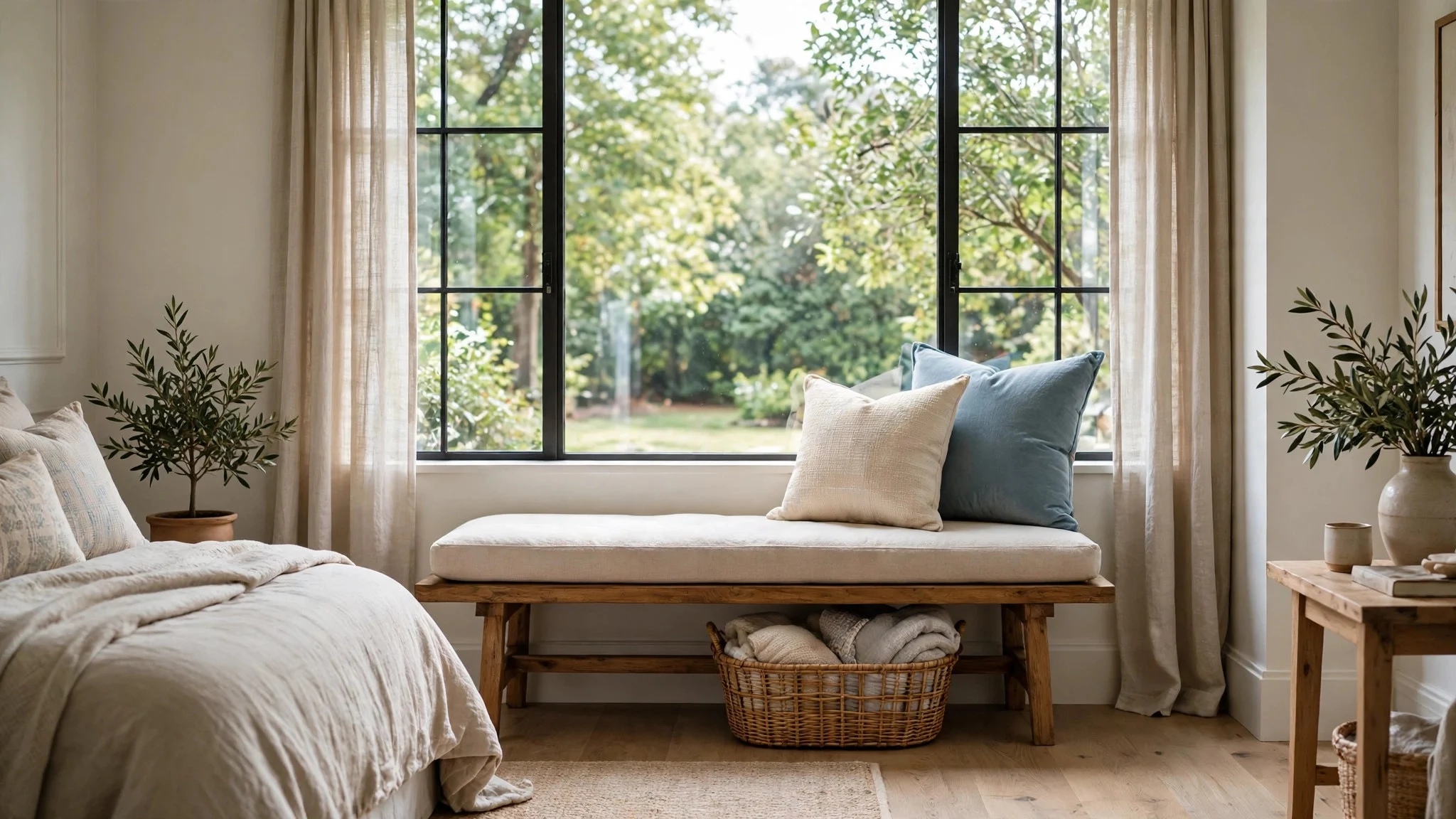
A low bench under a wide window is a simpler cousin of the built-in window seat, and it works in rented rooms where you cannot build anything. A bench 120 to 180 cm long, 35 to 45 cm deep, and 45 cm high fits under most windows without blocking the light. Add a cushion and two pillows, and it becomes a reading spot, a place to sit while putting on shoes, or extra seating for visitors. A solid wood or upholstered bench costs $150 to $500. Avoid a bench taller than the window sill — it blocks the view and looks awkward — and keep it clear of pooling curtains. Tip: keep a basket underneath for books or slippers, so the bench stays clear and the floor around it does not collect clutter.
10. Swivel Chairs for TV and Conversation
If the bedroom has a television, fixed chairs force a choice: face the TV or face each other — swivel chairs solve it. A swivel armchair turns toward the screen for a show and back toward the room for conversation, so the same two chairs serve both. Choose chairs with a smooth, quiet swivel base and a 70 to 80 cm seat. Expect $350 to $900 per chair, the swivel mechanism adding $50 to $150 over a fixed chair. Place the chairs 2 to 2.5 metres from the TV and keep the turning circle clear of rug edges and table legs. Avoid cheap swivel bases that squeak or wobble — a chair that moves when you do not want it to is worse than a fixed one. Tip: test the swivel in the shop with your full weight in the chair, turning slowly, and check the base does not lift or rock.

11. A Layout That Works in a 10 by 12 Foot Room
A 10 by 12 foot room, about 3 by 3.6 metres, is the tightest size where a small bedroom sitting area still works, and the layout has to be honest about what fits. Put the bed on the long wall with 40 cm nightstands each side. That leaves one short wall, usually by the window, for a single 75 cm chair, a floor lamp, and a 40 cm side table. Keep 75 cm of walkway between bed and chair, and skip the second chair. A single good chair, a lamp, and a table cost $400 to $1,000 all in, and fit without moving the bed. Tip: draw the layout on paper at scale before buying anything, marking the door swing and wardrobe doors — a chair that looks fine in a shop often lands exactly where a door needs to open.

12. A Layout for a Larger Room With Two Zones
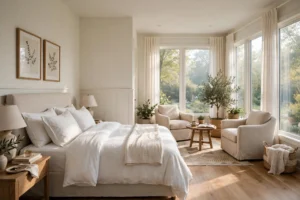
A room of 14 by 16 feet or more, about 4.3 by 4.9 metres, can hold a separate sitting area with two clear zones: sleeping and sitting. Place the bed at one end and the sitting area at the other, with a rug marking the boundary. Two armchairs and a table, or a loveseat and a chair, fit with 90 cm of walkway between zones. Budget $1,000 to $2,500 for the sitting zone: chairs, a table, a rug, and a lamp. Avoid filling the middle of the room with furniture — the open floor between the zones is what makes a large bedroom feel calm rather than crowded. Tip: use the same wood tone or fabric colour in both zones — matching nightstands and chair legs, for example — so the room reads as one space with two jobs, not two rooms pushed together.

13. Layered Lighting for the Sitting Corner
A sitting area with only a ceiling light gets used in the daytime and ignored at night. Layered lighting fixes that. A floor lamp beside the chair gives reading light, a small table lamp adds warmth, and a dimmer lets you lower the whole room for the evening. A floor lamp with an adjustable head costs $80 to $250, a table lamp $40 to $120, and a dimmer switch $15 to $40 fitted. Use warm 2700K bulbs in the sitting corner, so the light feels restful, not office-bright. Avoid a single bright bulb directly above the chairs — it casts hard shadows on a book and makes the corner feel exposed. Tip: put the floor lamp on your non-dominant side, so light falls across the page without your hand shadowing the words.

14. A Bookshelf Within Arm’s Reach
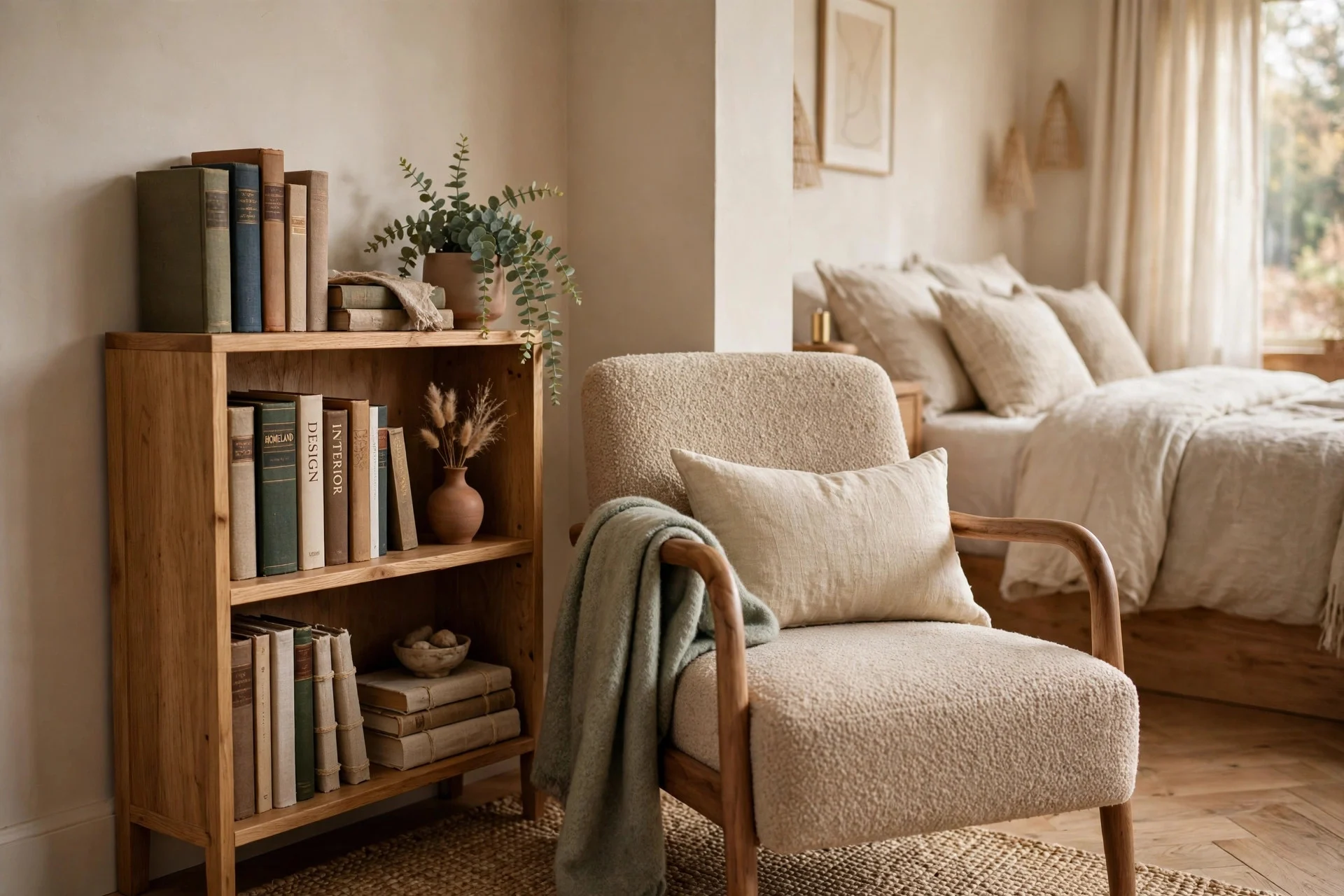
A sitting area without anything to read, look at, or do becomes a waiting room. A small bookshelf beside the chair fixes that and keeps the bedroom tidy. A shelf 60 to 90 cm wide with three or four shelves holds the books you are reading, a small plant, and a box for chargers or notebooks. A simple wooden shelf costs $80 to $250, and a wall-mounted shelf above the side table costs $40 to $100. Keep the top shelf reachable from the chair, and leave one shelf partly empty so the unit does not look stuffed. Tip: keep only the books you are reading or re-reading on this shelf, and move finished books back to the main shelf, so it stays useful instead of becoming storage.
15. An Ottoman and Tray Table That Moves Where You Need It
A storage ottoman with a tray table is the most flexible sitting area piece you can own, because it moves. Put your feet up while you read, slide it aside for floor space, or pull it to the other chair for your partner. A square ottoman 50 to 60 cm across costs $100 to $300, and a C-shaped tray table sliding over the chair arm costs $50 to $120. Choose an ottoman with a firm top so a tray sits steady, and a tray table with a lip so a mug does not slide off. Avoid an ottoman so large it blocks the walkway when it is not in use. Tip: store a folded throw inside it, so the chair is always ready for a cold evening without a blanket draped over the back all day.

FAQ
How much space do I need for a master bedroom sitting area?
A single chair with a side table and a lamp needs about 1.5 by 1.5 metres, including the walkway around it. Two chairs and a table need about 2 by 2.5 metres. In a 10 by 12 foot room that usually means one chair by the window, while a room of 14 by 16 feet or larger can hold two chairs or a small loveseat. Measure after the bed and nightstands are placed, not before — the bed takes the most room, and the sitting area gets what is left.
What is the best chair for a master bedroom sitting area?
The best chair is one with a firm seat, a back high enough to support your shoulders, and arms you can rest a book on. A seat height of 45 to 48 cm suits most people, and a width of 70 to 80 cm gives room to sit comfortably without taking over the corner. Sit in it for five minutes before buying, and check you can stand up easily with a mug in hand. A chair that is hard to get out of will end up holding clothes instead of a reader.
How do I stop the sitting area from becoming a dumping ground?
Give everything a place and keep the area easy to sit in. A basket beside the chair holds the throw and the book you are reading, a tray on the table holds a mug and a phone, and a hook or a valet stand by the door takes the jacket that would otherwise land on the chair. The habit that matters most is a one-minute reset each morning: fold the throw, clear the table, and put the book back on the shelf. A chair that is ready to sit in gets sat in, and a chair covered in clothes does not.
Conclusion
A master bedroom sitting area gets used when it is built around a real habit, not a picture. Pick the spot with the best light, put a chair there comfortable for twenty minutes, add a table for a mug and a lamp for the evening, and leave room to walk in and out without a shuffle. In a small room that means one good chair by the window — a simple bedroom reading nook. In a larger room it can mean two chairs, a rug, and a coffee spot. Measure first, buy the chair you sat in, and keep the area clear with a one-minute morning reset. Do that, and the corner stops being a place where clothes pile up and starts being the quietest, most-used seat in the house.