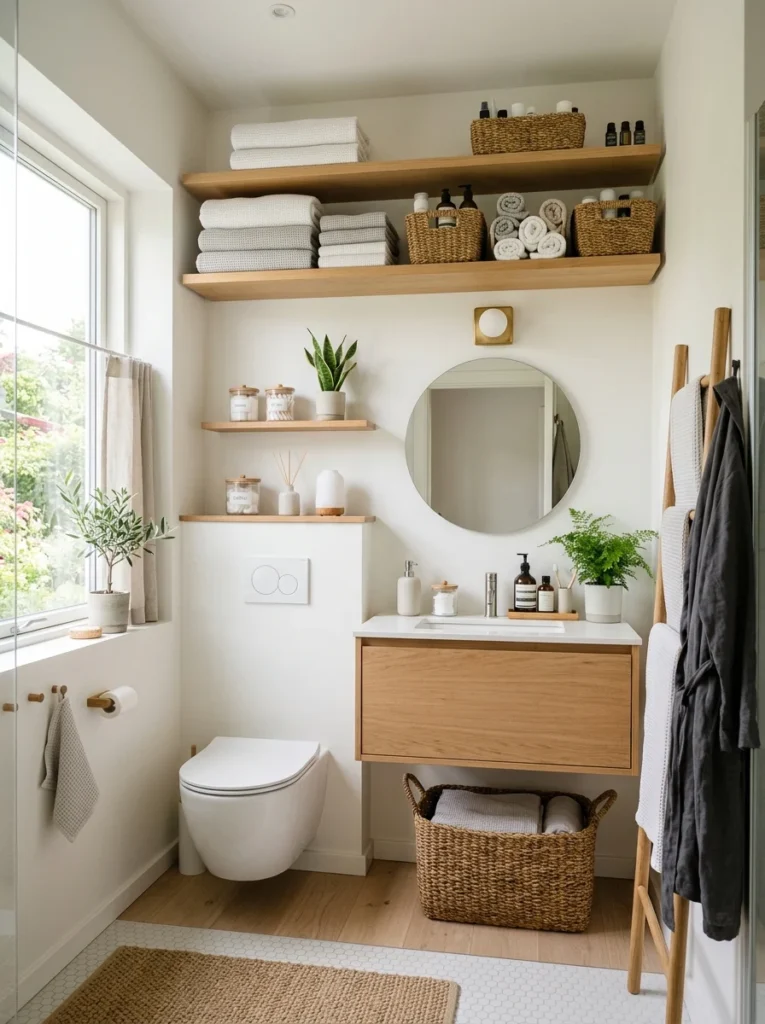
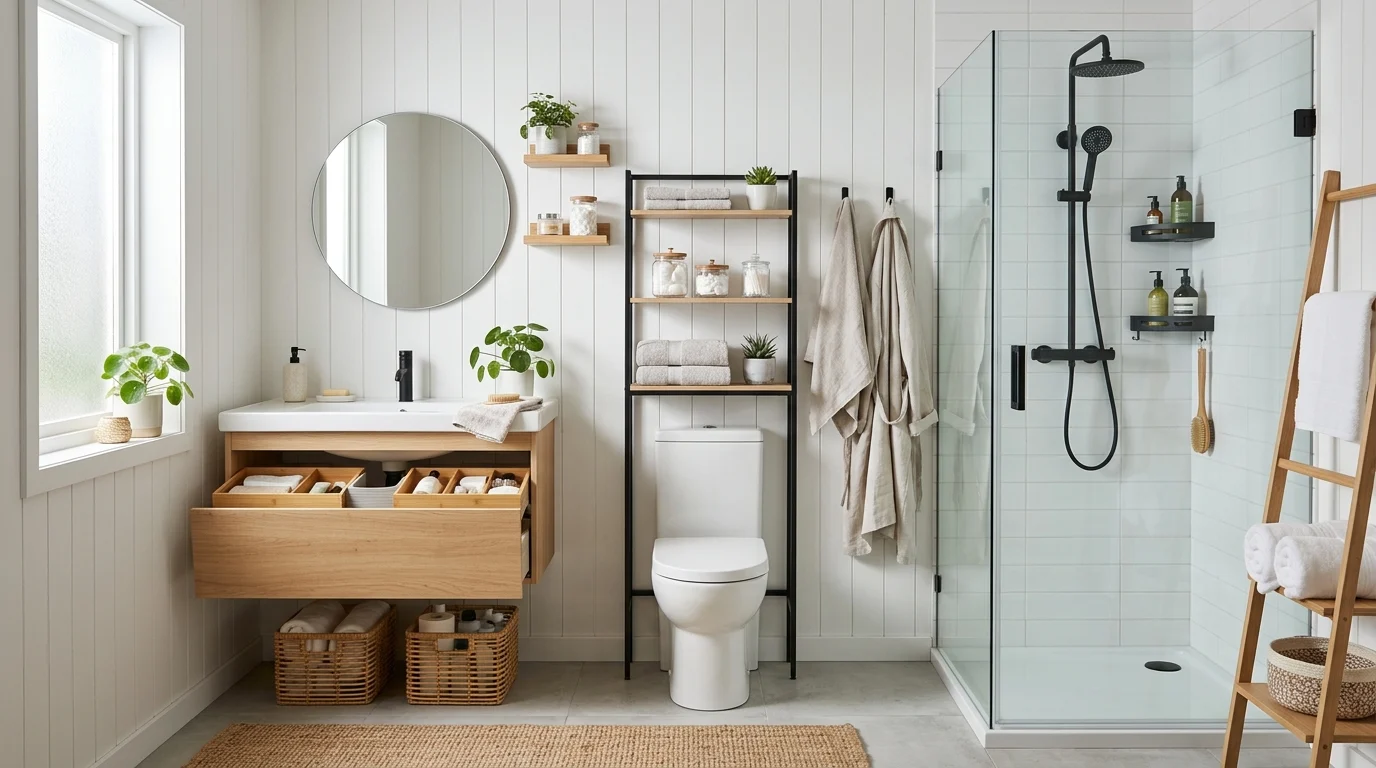
For years, my bathroom cabinet was the kind of mess where you’d open the door and something would fall out. Extra toothbrushes, half-used bottles, and a hairdryer cord tangled around everything else, all crammed into one small cabinet under the sink. It wasn’t that I owned too much; it was that I had never actually thought about where things should live. Once I started treating storage as a system rather than an afterthought, giving every category of item an actual assigned spot, the same small bathroom suddenly felt twice as big and infinitely calmer to use every morning.
The 25 ideas below are grouped by area, so you can tackle the parts of your bathroom that bother you most first. None of them require a renovation, and most can be done in an afternoon with items you can find at almost any home store. The goal isn’t to buy more organizing products; it’s to finally give everything you already own a real, consistent home.
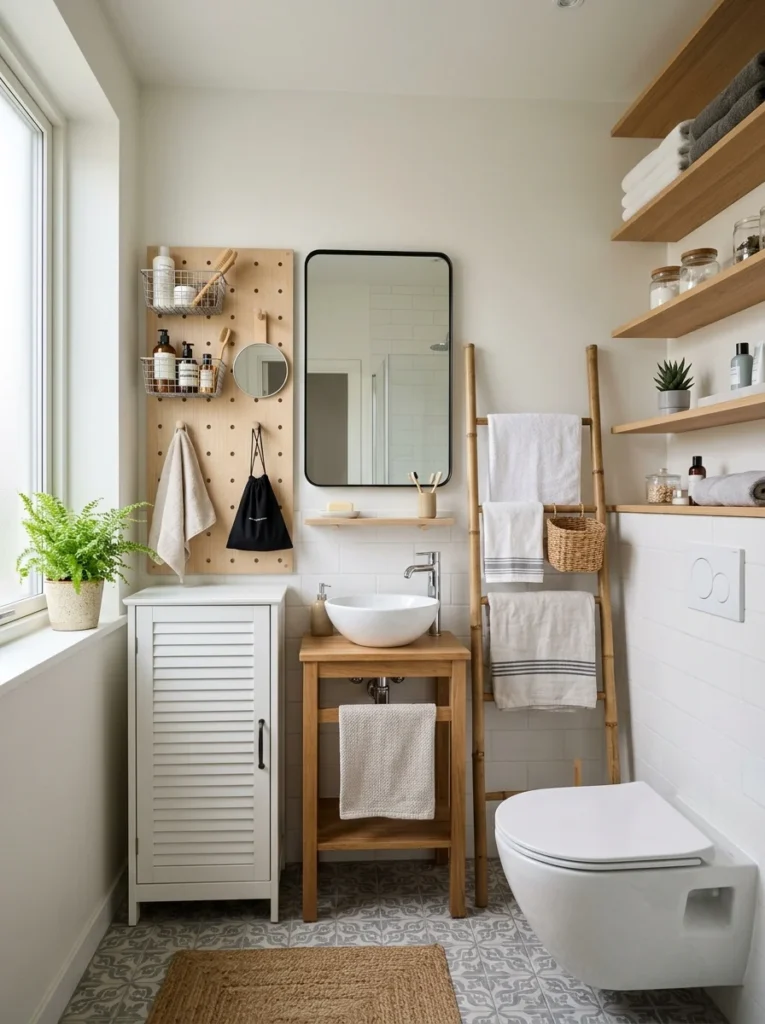
Vertical storage ideas: use the wall, not just the floor
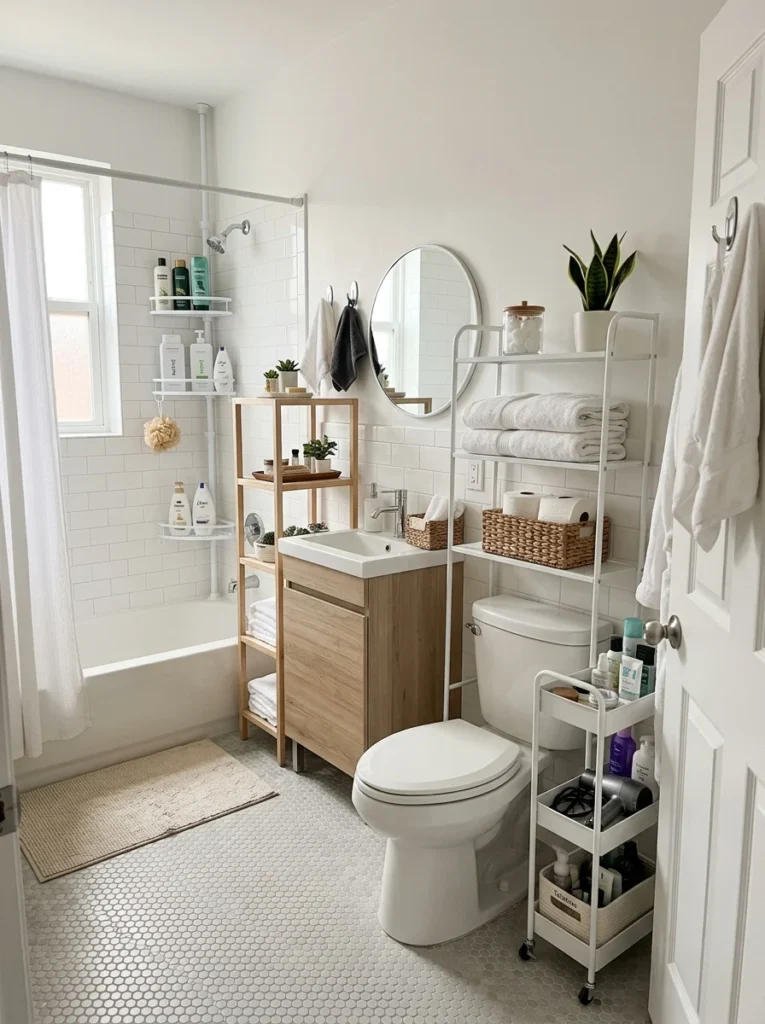
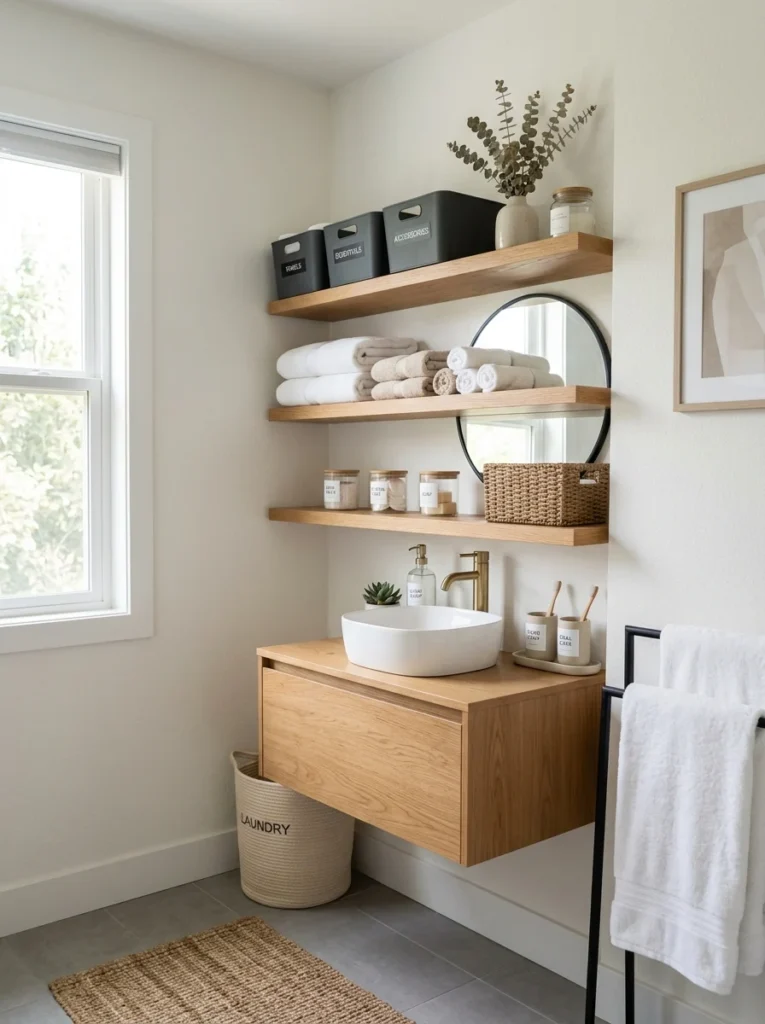
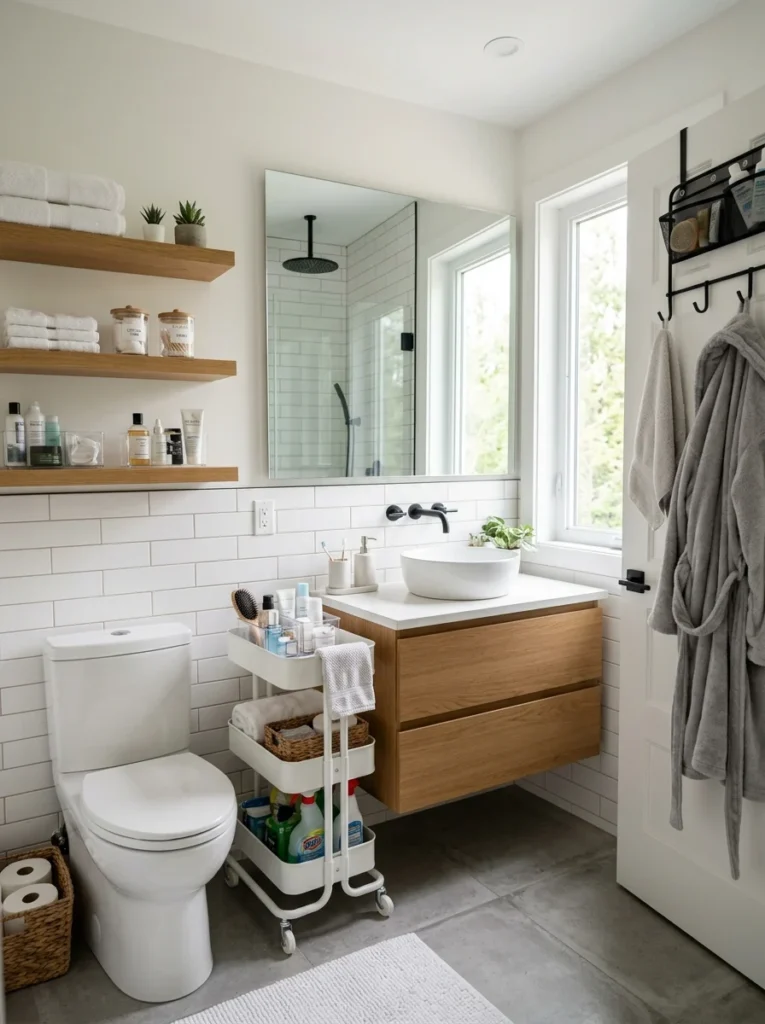
In a small bathroom, wall space is almost always underused while floor space gets crowded. Start by installing a tall, narrow cabinet in any unused corner; it holds nearly as much as a wide dresser while taking up a fraction of the footprint. Add a ladder shelf leaning against an open wall for towels and baskets, since it requires no drilling and can be moved if you rearrange later. Mount a row of adjustable shelves above the toilet, an area that’s almost always empty, for extra towels or backstock supplies. Hang a pegboard on one wall and use hooks and small baskets to hold hair tools, jewelry, or robes, which keeps items visible and off the counter. Finally, use the back of the door for an over-the-door organizer with clear pockets, ideal for hair products, cleaning supplies, or first-aid items you want within reach but out of sight.
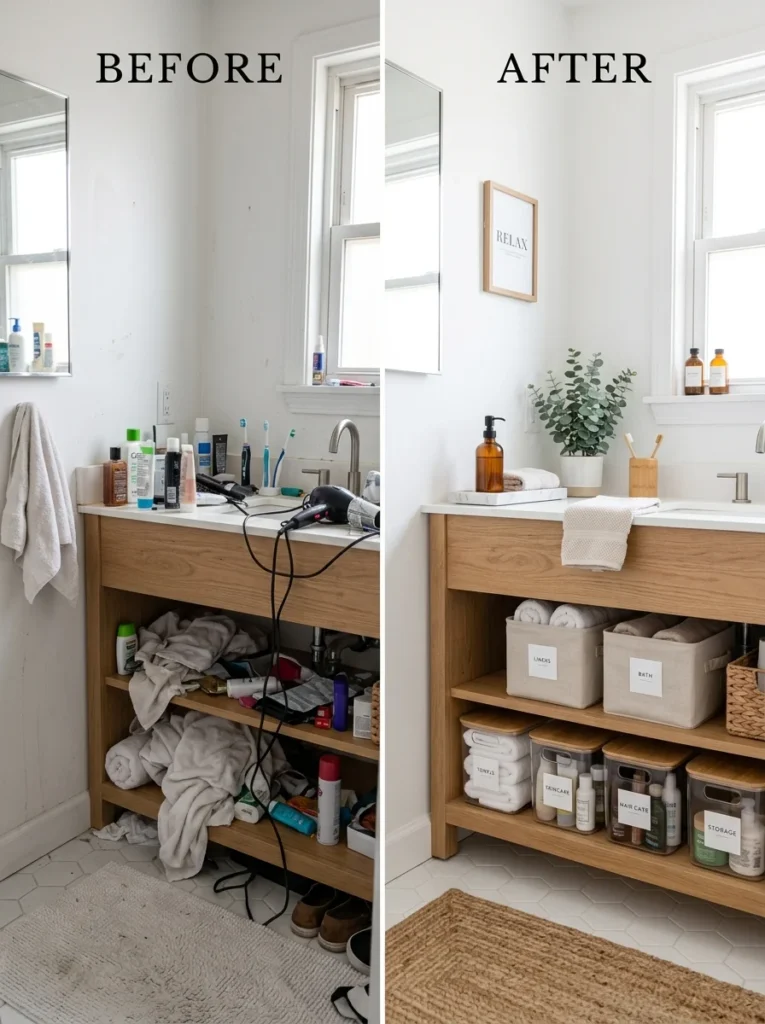
Under-sink storage ideas: make the cabinet actually usable
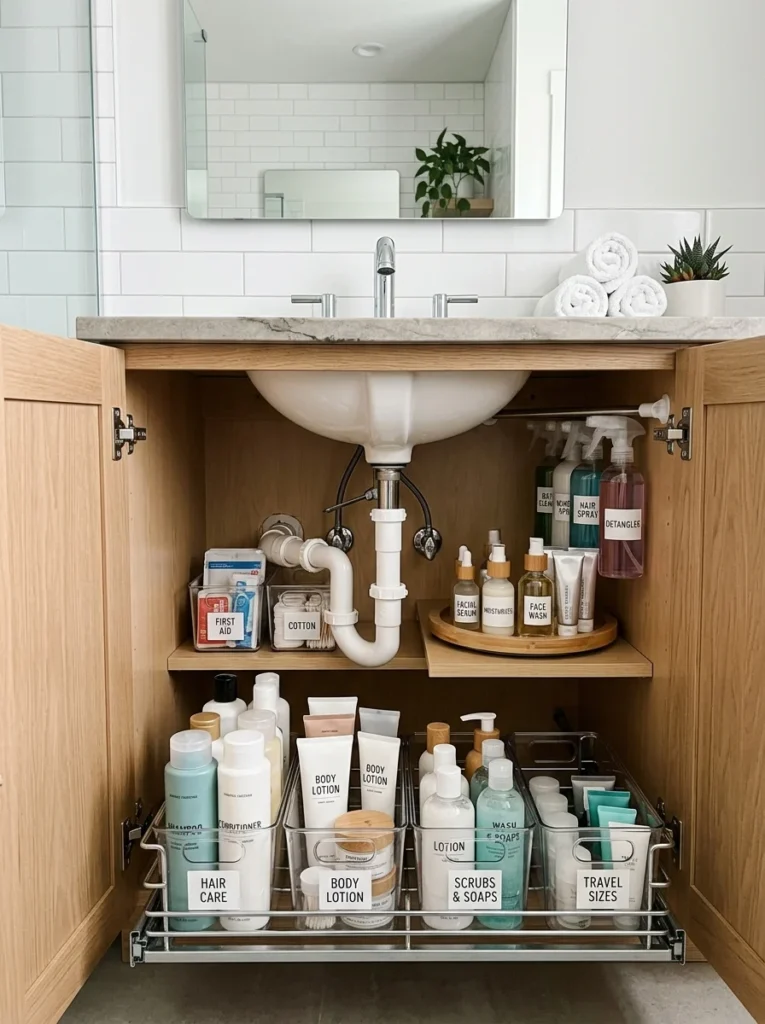
The cabinet under the sink is often the most wasted storage in the whole bathroom, mostly because pipes cut the usable space into odd shapes. Add stackable, pipe-friendly bins designed specifically to fit around plumbing, which instantly doubles the usable volume compared to just piling items on the cabinet floor. Install a pull-out drawer organizer if your cabinet has enough depth, since drawers make it far easier to see and reach items at the back than a fixed shelf does. Use a lazy Susan turntable for bottles and cleaning products, so nothing gets lost or forgotten in a back corner. Add a tension rod partway up the cabinet to hang spray bottles by their handles, freeing up the floor of the cabinet for bulkier items. Label bins by category, cleaning, hair, extra toiletries, so everyone in the household puts things back in the same place instead of creating a new pile of clutter each week.
Shower and tub storage ideas: keep the wet zone organized
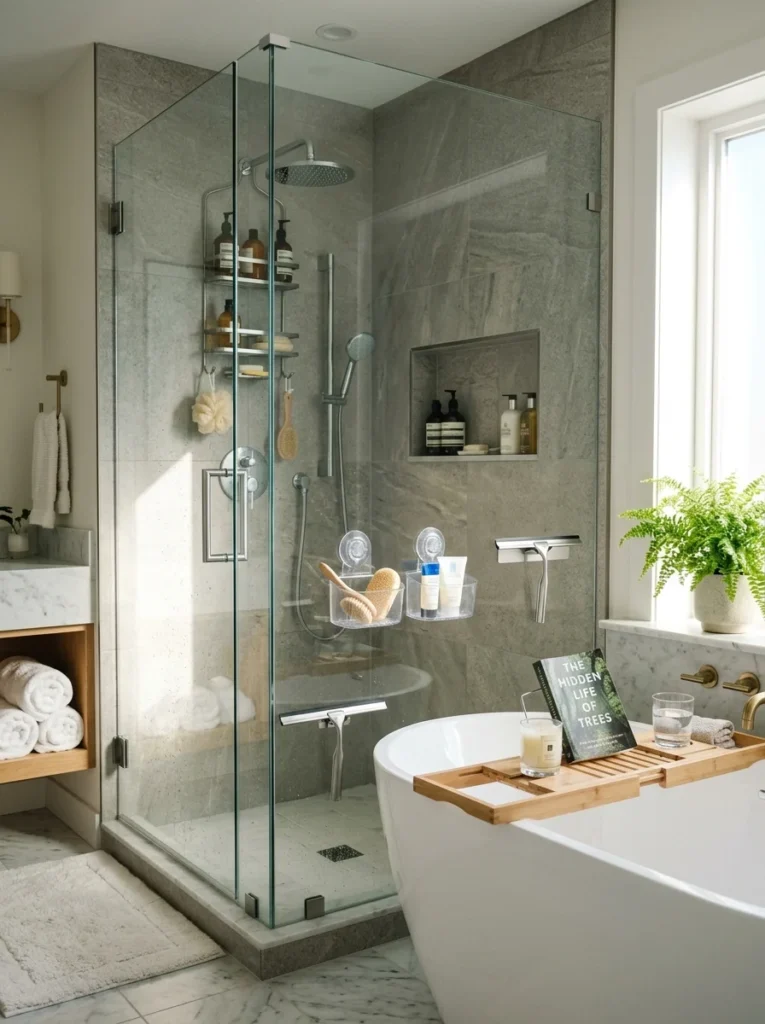
A cluttered shower with bottles balanced precariously on the tub edge is both an eyesore and, honestly, a minor safety hazard. A recessed or corner shower caddy that hangs from the showerhead keeps shampoo, conditioner, and soap organized without drilling into tile, and it’s easy to remove if you switch homes later. If you’re renovating, a built-in tile niche is a more permanent and cleaner-looking solution that keeps the shower wall flush and uncluttered. Use a suction-cup or tension-mounted basket for razors and loofahs, keeping them off the shower floor where they can create buildup. Add a small teak or plastic bath tray across the tub for candles, a book, or a drink during a bath, which keeps those items from cluttering the surrounding surfaces. Finally, use a wall-mounted squeegee holder near the shower so the squeegee itself, an easily misplaced item, always has an obvious, consistent home.
Vanity and countertop storage ideas: clear surfaces, real systems
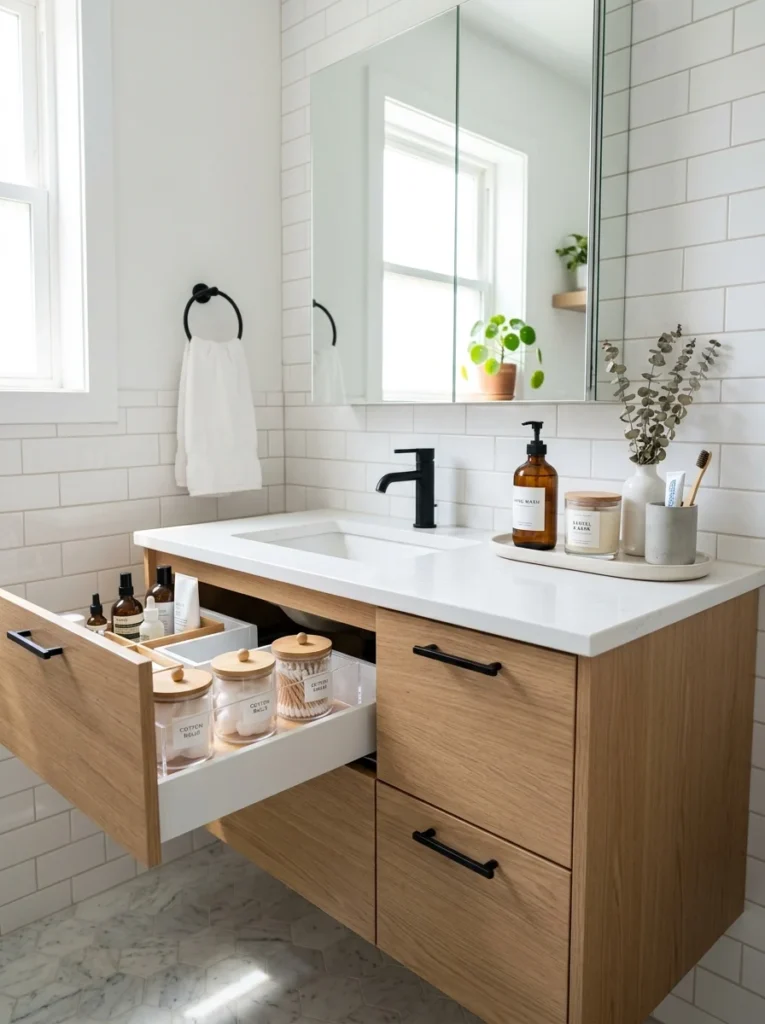
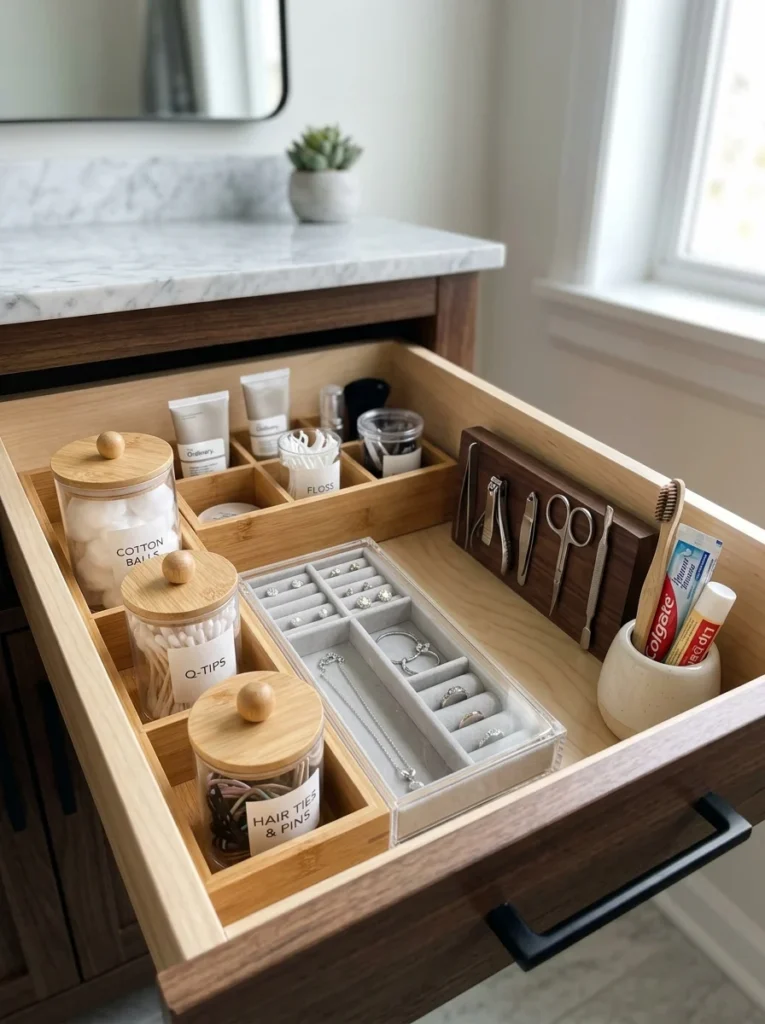
A clear countertop does more to make a small bathroom feel organized than almost any other single change. Use a drawer divider insert in the vanity drawers to keep makeup, skincare, and grooming tools separated instead of sliding into a jumbled pile every time the drawer opens. Add a small tiered organizer inside a cabinet for skincare bottles, so smaller items in the back aren’t hidden behind larger ones in front. Use a countertop tray to corral the few items you do want visible, a soap dispenser, a candle, a small plant, since grouping items on a tray reads as intentional rather than cluttered even when the tray itself holds several things. Mount a small medicine cabinet with a mirrored front if you don’t already have one, since it adds a meaningful amount of enclosed storage without taking up any additional floor or counter space. Finally, use small labeled jars or containers for cotton balls, cotton swabs, and bath salts, which look tidier than keeping them in their original plastic packaging and make it easy to see when you’re running low.
Towel and linen storage ideas: stop the pile-up
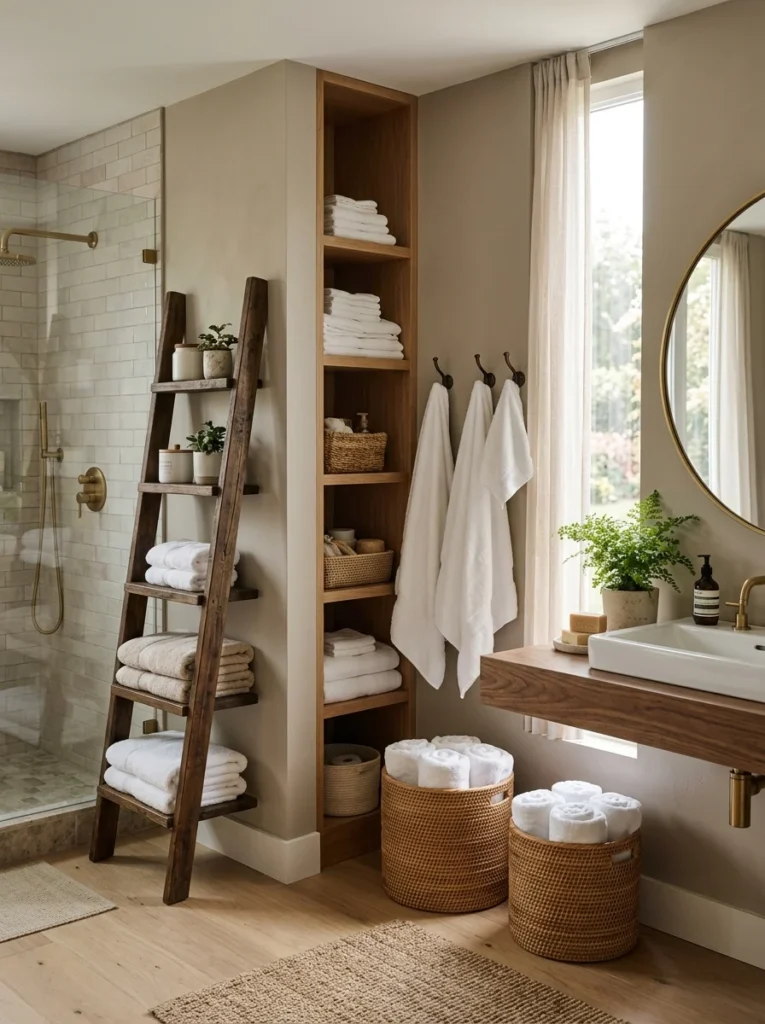
Towels are often the single biggest source of visual clutter in a small bathroom, mostly because there’s rarely a designated spot for more than one or two at a time. Install hooks instead of, or in addition to, a single towel bar, since hooks let you hang more towels in the same wall space and make it easier for kids or guests to actually hang towels up rather than leaving them on the floor. Use a woven basket or ladder shelf specifically for spare towels, so they have a clear home instead of getting stuffed into an already-crowded linen closet. Roll rather than fold towels when storing them in a basket, since rolled towels take up less space and are easier to grab one at a time without disturbing the rest. Add a small shelf or cubby specifically for bath mats, since a damp bath mat left on the floor is both a clutter and a hygiene issue. Finally, if space allows, dedicate one small shelf purely to guest towels, kept separate from everyday ones, so you’re not searching through a pile to find a fresh one when visitors come over.
Small item and everyday clutter ideas: the final details
The smallest items are often what create the most visual chaos, so give them explicit homes too. Use a small cup or holder specifically for toothbrushes and toothpaste, kept off the main counter surface. Add a magnetic strip inside a cabinet door for metal items like tweezers, nail clippers, and bobby pins, which keeps them from sliding to the bottom of a drawer. Use a small caddy or tray inside a drawer specifically for jewelry removed before showering, so rings and earrings don’t end up scattered across the counter. Keep a small labeled bin for expired or nearly empty products that need to be tossed, checked and cleared out monthly, so clutter doesn’t quietly accumulate over time. Finally, do a five-minute reset each week, putting anything that’s drifted out of place back into its designated spot, since consistent small resets prevent the kind of overwhelming clutter that eventually requires a full weekend to fix.
Renter-friendly storage ideas: no drilling required
If you’re renting and can’t drill into walls or tile, several of these ideas still work using tension rods, adhesive hooks, and freestanding furniture instead of permanent fixtures. Tension shower caddies and tension rods for cabinets require no hardware and come down cleanly when you move. Command-style adhesive hooks, rated for the weight of what you’re hanging, work well for lightweight items like loofahs, robes, or small baskets, and they remove without damaging paint when used correctly. Freestanding shelving units and rolling carts add substantial storage without touching the walls at all, which makes them ideal for a rental where any permanent changes need approval first. A slim over-the-toilet étagère is another renter-friendly option, since it stands independently and simply straddles the toilet, adding real shelf space without a single screw.
Family bathroom storage ideas: making it work for kids too
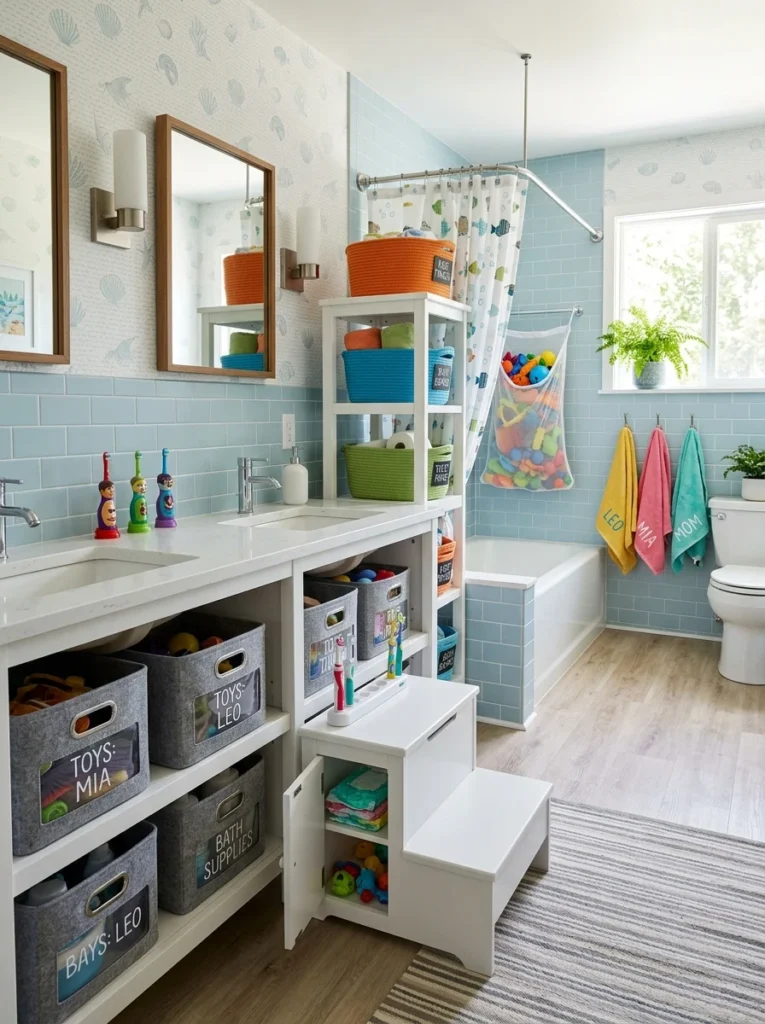
A shared family bathroom needs storage that works at a child’s height, not just an adult’s. Add a low shelf or basket within a child’s reach for their own toothbrush, cup, and bath toys, so they can get what they need without asking for help or rummaging through an adult’s supplies. Use a stepping stool that doubles as storage underneath, so the extra height they need to reach the sink also holds a small basket of their items. Keep bath toys in a mesh bag that hangs to dry over the tub rather than piling them loose in a corner, which prevents mildew and keeps the tub edge clear. Assigning each child their own labeled bin or shelf, rather than one shared jumble, also cuts down on daily arguments over whose items are whose.
The habit that matters more than any single product
Buying organizers is only half the solution. The real shift happens when every category of item, hair tools, medications, cleaning supplies, guest towels, has one specific, consistent spot, and everyone using the bathroom actually returns items there. Without that habit, even the best storage systems slowly drift back into clutter within a few weeks. The fastest way to build the habit is to declutter first, removing anything expired, unused, or duplicated, before organizing what’s left, since it’s much easier to maintain a system for fewer items than to force too many items into too little space.
Common bathroom storage questions
How can I add storage to a bathroom with no extra floor space?
Focus entirely on vertical and door-mounted solutions when floor space is completely gone: wall shelves above the toilet, an over-the-door organizer, hooks instead of a bulky hamper, and a slim wall-mounted cabinet. These options add real storage capacity without requiring a single square foot of floor space, which makes them the best starting point for genuinely tight bathrooms.
What’s the best storage solution for a bathroom with no cabinets?
Wall-mounted shelving, an over-the-door organizer, and a rolling cart are the most practical options when a bathroom has little to no built-in storage. A slim rolling cart is especially useful since it can be tucked beside the toilet or vanity and moved easily when you need to clean.
How do I stop my bathroom counter from looking cluttered?
Keep only a few intentional items on the counter, group them on a small tray, and move everything else into drawers, cabinets, or wall storage. A daily habit of putting items away after use, rather than leaving them out for convenience, matters just as much as the organizing tools themselves.
What should I declutter before organizing my bathroom?
Start with expired medications and skincare products, duplicate travel-size toiletries, and any tools or gadgets you haven’t used in the past six months. Clearing these out first makes the remaining organizing project significantly smaller and easier to maintain long-term.
Small space, real systems
A small bathroom can hold everything a household actually needs without ever feeling cluttered, as long as every item has a clear, consistent home and the space is organized by zone rather than tackled all at once. Start with whichever area bothers you most, the vanity, the shower, the under-sink cabinet, and work through the rest as time allows. None of these 25 ideas require a renovation or a large budget, and most can be completed in a single afternoon using tools you likely already have or can pick up cheaply. The bathroom that used to spill something every time I opened the cabinet is now the easiest room in my house to keep tidy, not because I have less stuff, but because everything finally has somewhere to go.