
A plain painted wall can feel finished, but it rarely changes how a room feels. Texture, depth, and natural material do that work instead. A slatted timber wall warms a cool, white room. A limewashed wall softens harsh daylight. A stone or tile feature gives a flat wall a focal point without shouting for attention. The trick is choosing one wall — usually the one behind the sofa, the fireplace wall, or the longest uninterrupted wall — and letting the other three stay quiet. That restraint is what keeps an accent wall looking intentional rather than busy. In this guide you will find fifteen practical options, each with realistic sizes, costs, and mistakes to avoid, so you can match the idea to your room, your budget, and how much upkeep you are willing to live with. Most of these can be done in a weekend, and several are renter-friendly. Read each idea fully before buying materials, because wall condition and light change the result.
Vertical Wood Slat Wall
Vertical wood slats are narrow timber battens fixed to a wall with a small gap between each one, creating rhythm, shadow, and warmth in one move. Use battens around 25 to 40 mm wide and 12 to 20 mm deep, spaced 10 to 20 mm apart, running floor to ceiling on a single wall. Oak, walnut veneer, or painted pine all work; pre-made acoustic slat panels cost roughly $25 to $60 per square foot installed, while DIY pine battens run $150 to $400 for a 10-foot wall. Paint the wall behind the slats a dark charcoal or matching tone first, so the gaps read as shadow, not bare plaster. Avoid stopping slats at picture-rail height, which chops the room in half — run them full height. Practical tip: start from the centre and work outward, so any narrow cut battens land symmetrically at the edges.
Reclaimed Timber Plank Wall
A reclaimed plank wall uses varied-width boards in mixed tones to give a living room instant age and character, without a full renovation. Source kiln-dried reclaimed boards or new boards with a weathered finish, in widths of 100 to 150 mm, and fix them horizontally or vertically over a plywood backer. Budget $12 to $30 per square foot for materials, plus $300 to $800 for labour on a standard sofa wall if you hire out. Check every board for nails, warping, and smell before fixing, and seal the finished wall with a matte clear coat to stop dust and splinters. Avoid mixing more than three wood tones, which quickly looks patchy rather than collected. Practical tip: lay the boards on the floor first and photograph the arrangement, so you keep the best colour balance when you start fixing.
Limewash Plaster Finish
Limewash is a mineral paint made from crushed limestone that dries with soft, cloudy movement instead of a flat, uniform colour. Apply two to three thin coats with a block brush in loose, criss-cross strokes over a primed wall, letting each coat dry for at least four hours. A litre covers roughly 80 to 100 square feet per coat and costs $45 to $85, so a single accent wall usually needs two litres and a $20 brush. Limewash suits plaster and drywall, but it will not hide cracks or rough patches, so fill and sand first. Avoid rolling it on like emulsion, which kills the mottled effect and leaves lap marks. Practical tip: test a 2-foot square in daylight and lamplight before committing, because limewash shifts noticeably between warm and cool light.
Microcement and Venetian Plaster
Microcement and Venetian plaster give a seamless, stone-like surface with subtle trowel marks and no grout lines or joints. A professional applies two to four thin layers over a prepared wall, then seals it, for a total thickness of only 2 to 3 mm. Expect $15 to $35 per square foot installed for microcement and $20 to $45 for Venetian plaster, with most living room walls costing $1,500 to $3,500 in total. These finishes suit modern rooms, fireplace surrounds, and curved walls, and they wipe clean once sealed. Avoid DIY kits on a first attempt for a large wall, as trowel pressure differences show up as uneven patches. Practical tip: choose a mid-tone, not pure white, because it hides scuffs from sofa backs and shows the trowel texture better.
Stacked Stone Veneer
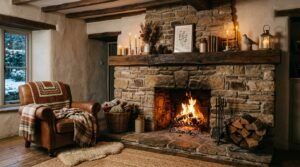
Stacked stone veneer is made of thin, real or manufactured stone strips fixed in horizontal courses, giving the look of a dry-stone wall at a fraction of the weight. Panels are typically 600 mm wide and 150 to 300 mm tall, and the finished wall adds about 25 to 40 mm of depth. Materials cost $10 to $25 per square foot, with installation adding $15 to $30 per square foot, so a 10-by-8-foot wall usually totals $2,000 to $4,400. Fix panels to a sound, level wall with stone adhesive and a ledger board for the first course, and seal porous stone annually. Avoid running stone around corners without mitred or corner pieces, which leaves raw, unfinished edges. Practical tip: light it from above with a 3000K picture light or recessed spots, because side light brings out the texture far better than a ceiling pendant alone.
Thin Brick Veneer
Thin brick veneer uses real clay brick slices, about 12 to 15 mm thick, to bring loft-style warmth to a living room without the weight or depth of a full brick wall. Lay them in a running bond pattern with 10 mm mortar joints, or use pre-grouted panels for a faster job. Brick slices cost $8 to $18 per square foot, plus mortar and labour, bringing a typical accent wall to $1,200 to $3,000 installed. This works best on one wall only, behind a sofa or fireplace, paired with plain plaster elsewhere. Avoid painting over new brick immediately, as trapped moisture can cause peeling, and avoid whitewashing every brick evenly, which looks flat. Practical tip: leave one or two bricks slightly proud or vary the mortar tone, because that small imperfection is what makes veneer read as real brick.
Fluted Wall Panels
Fluted panels are vertical, ribbed boards — in MDF, wood veneer, or lightweight polyurethane — that add tailored, architectural rhythm without a joinery budget. Standard panels measure 2400 mm tall and 120 to 300 mm wide, with ribs 15 to 25 mm deep, and cost $6 to $20 per square foot for materials. Glue or pin them to a flat wall, mitre the joins, and paint or stain to match your trim for a built-in look. They suit the wall behind a sofa, a hallway-facing living room wall, and alcoves that need structure. Avoid using deep flutes in a very narrow room, where the ribs can make the wall feel closer, and avoid stopping the panels mid-wall. Practical tip: paint the panels and the skirting the same colour, so the wall reads as one piece of architecture rather than an add-on.
Modern Shiplap
Modern shiplap is horizontal or vertical boards with a small shadow gap, painted or left natural, that adds calm, coastal or farmhouse structure to a flat wall. Use boards 150 mm wide with a 3 mm nickel gap, fixed over studs or a plywood backer, running the full wall width. Primed MDF shiplap costs $4 to $10 per square foot, while real pine or cedar runs $8 to $18, and a single wall usually costs $400 to $1,200 in materials. Paint it the same white as the trim for a subtle effect, or a deep green or navy for contrast. Avoid shiplap on all four walls, which turns a living room into a box, and avoid short, staggered offcuts that break the long lines. Practical tip: run boards horizontally to widen a narrow room, and vertically to make a low ceiling feel taller.
Board-and-Batten Picture-Frame Moulding
Picture-frame moulding uses flat timber battens to form large rectangles on a wall, giving a classic, panelled look for very little money. Plan rectangles 600 to 900 mm wide and 900 to 1200 mm tall, with 50 to 75 mm wide battens, keeping a 100 to 150 mm margin from corners, skirting, and ceiling. Primed pine battens cost $1 to $3 per linear foot, so a full wall of four frames often costs under $250 in materials plus paint. Fix with adhesive and pins, fill nail holes, caulk the edges, and paint wall and moulding the same colour for a seamless finish. Avoid uneven spacing or frames that clash with door heights, which the eye catches instantly. Practical tip: draw the layout in painter’s tape first and live with it for a day before cutting anything.
Upholstered Fabric Panels
Upholstered panels are padded, fabric-wrapped boards fixed to a wall, adding softness, sound absorption, and a boutique-hotel feel to a seating wall. Make or buy panels 600 by 600 mm or 600 by 1200 mm, with 25 to 50 mm foam over plywood, wrapped in a stain-resistant linen, velvet, or bouclé. Ready-made panels cost $25 to $70 each, so a sofa-width feature of six to eight panels runs $300 to $700. They work well behind a sofa, in a reading corner, or on a bedroom-facing living room wall, and they noticeably soften echo in hard-floored rooms. Avoid pale velvet if you have pets that shed, and avoid fixing panels with visible screws. Practical tip: use French cleats or hook-and-loop strips, so you can remove a single panel for cleaning without disturbing the rest.
Oversized Mural Wallpaper
A large-scale mural wallpaper turns one wall into a botanical print, scenic view, or abstract artwork, without framing or hanging anything. Choose a mural sized to your wall — most suppliers print panels for walls 3000 to 5000 mm wide — and order 100 to 150 mm extra on each side for trimming. Paste-the-wall murals cost $150 to $500 for a standard wall, while peel-and-stick versions cost $120 to $350 and suit renters. Hang from the centre outward, match the pattern at eye level first, and keep furniture low so the design stays visible. Avoid a busy mural behind a busy sofa fabric, as the two patterns will fight. Practical tip: pick a mural with a quiet, empty area on one side, and place your sofa or console there so the art and furniture share the wall calmly.
Cork Wall Tiles
Cork tiles bring warm, natural texture and real acoustic benefit to a living room, and they are one of the easiest accent walls to install yourself. Tiles usually measure 300 by 300 mm or 600 by 300 mm and 6 to 10 mm thick, and cost $5 to $12 per square foot. Glue them in a brick or stacked pattern, mix natural and dark-stained tiles for a subtle checker effect, and seal with a matte polyurethane for durability. Cork suits a reading wall, a home office corner inside a living room, and rooms with echo from hard floors. Avoid placing raw cork directly behind a fireplace or radiator, where heat can dry and crack it. Practical tip: buy 10 percent extra and shuffle tiles from different boxes, because natural cork varies in tone and a single-box run can show banding.
Antique Mirror Tiles
Antique mirror tiles are foxed, lightly distressed mirror panels that reflect light and double the sense of space without the cold, gym-like feel of plain mirror. Use tiles 300 by 300 mm or 600 by 600 mm, fixed with mirror adhesive and small edge trim, on a single wall opposite a window for maximum light gain. Tiles cost $15 to $35 per square foot, and a 6-foot-wide feature usually totals $800 to $2,000 installed. They suit small or dark living rooms, entry-facing walls, and dining corners inside an open-plan room. Avoid covering a full wall floor to ceiling in a room where people sit close, as reflections become distracting. Practical tip: keep the mirror wall behind or beside seating, not directly opposite the main sofa, so you are not staring at your own reflection all evening.
Preserved Moss Wall
A preserved moss wall uses real, preserved moss — not living plants — fixed to a backer board, so you get a lush green feature with no watering, light, or pruning. Panels come in 500 by 500 mm or 1000 by 500 mm sizes, cost $40 to $90 per square foot, and a sofa-width feature of 8 by 4 feet typically costs $1,300 to $2,900. Preserved moss needs indoor humidity between 40 and 60 percent and no direct sun, which would fade it, but otherwise lasts five to ten years. It suits a nature-led living room, a plain wall that needs softness, and rooms where paint feels too flat. Avoid mixing preserved moss with live plants on the same wall, as watering the live plants will damage the preserved moss. Practical tip: frame the moss with a slim timber border, which stops edges fraying and makes the feature look finished rather than stuck on.
Handmade Zellige Tile Feature
Handmade zellige tiles are small, glazed Moroccan tiles with uneven edges and varied glaze, giving a living room wall a crafted, light-catching surface. Use tiles around 100 by 100 mm or 50 by 150 mm in a stacked or herringbone pattern, with narrow 2 to 3 mm grout joints that follow the tiles’ irregular edges. Tiles cost $15 to $35 per square foot, and a fireplace surround or 6-foot-wide feature usually totals $900 to $2,500 installed. Choose one glaze colour — sage, terracotta, cream, or deep green — and let the variation do the work. Avoid large-format imitation tiles if you want this look, as perfect uniformity removes the handmade charm. Practical tip: order a sample of five to ten tiles first and view them in your room’s light, because glaze colour shifts far more than catalogue photos suggest.
Frequently Asked Questions
Which wall should be the accent wall in a living room?
Choose the wall your eye lands on first when you enter, usually the sofa wall, the fireplace wall, or the longest uninterrupted wall. Avoid walls broken by many doors or windows, because the feature gets chopped up. If your room is open-plan, pick the wall that anchors the seating area, and keep the other walls plain so the feature has room to breathe.
Can I have an accent wall in a small living room?
Yes, and texture often works better than a dark colour in a small room. Light-toned slats, limewash, fluted panels, or antique mirror tiles add depth without shrinking the space. Keep the feature to one wall, keep furniture low and light in front of it, and avoid very dark stone or brick on every surface, which can make a compact room feel enclosed.
What is the cheapest accent wall idea that still looks good?
Board-and-batten picture-frame moulding and painted shiplap are the best value options, often under $300 in materials for a single wall. Peel-and-stick mural wallpaper and cork tiles are also budget-friendly and renter-safe. Spend the saving on good paint, neat caulking, and proper preparation, because clean edges matter more than expensive materials.
Conclusion
An accent wall works when it adds texture, warmth, or a clear focal point without competing with everything else in the room. Start with one wall, choose a material that suits your light, your furniture, and your tolerance for upkeep, and keep the remaining walls calm. Whether you pick slatted timber, limewash, stone, mirror, or moss, the details — full-height runs, neat edges, and the right lighting — are what turn a feature wall from a weekend experiment into a lasting part of the room. Measure twice, test a sample in your own light, and let the wall earn its place.