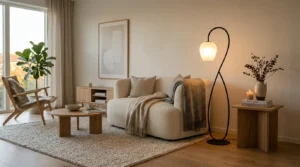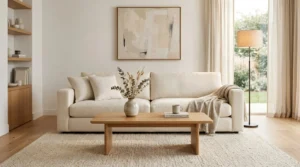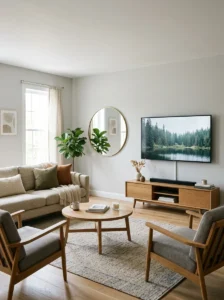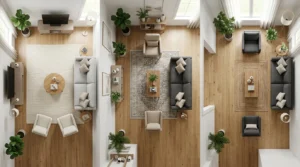
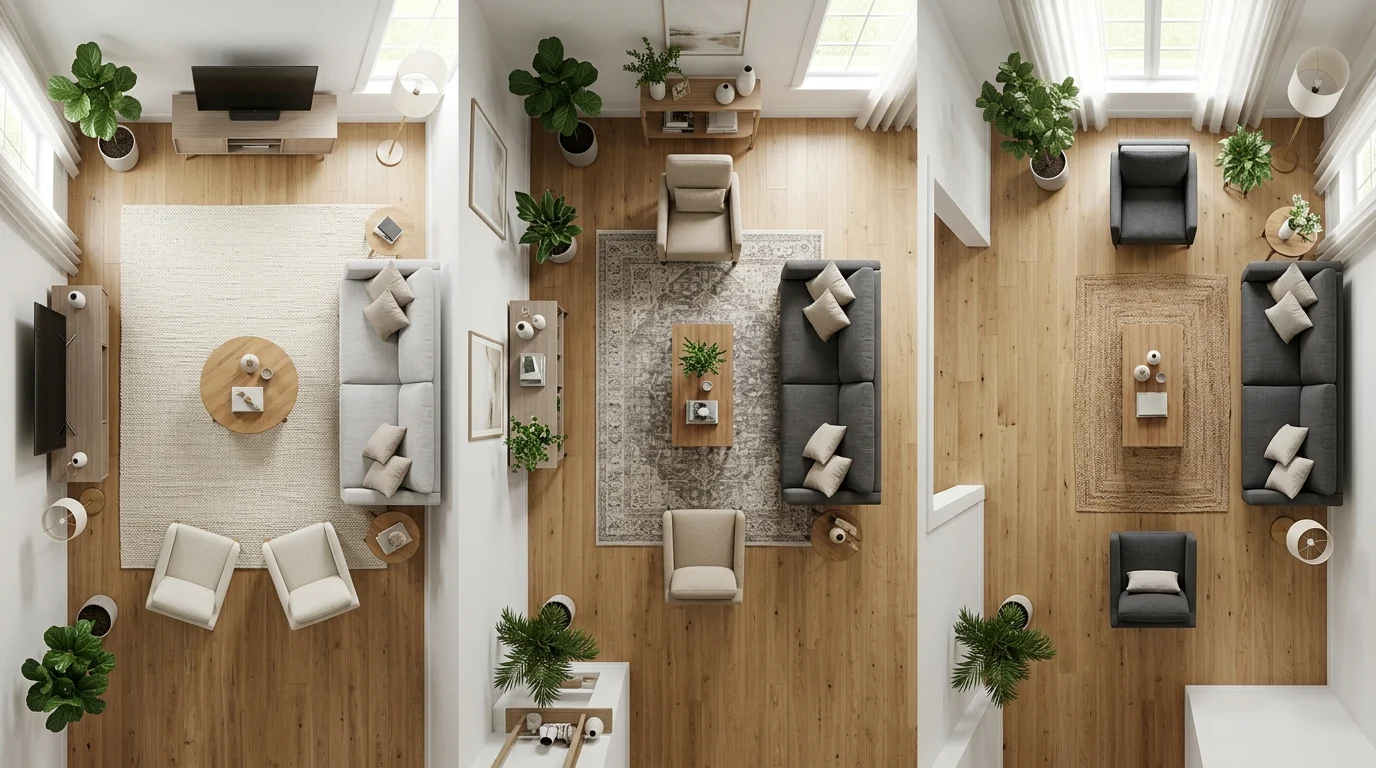
A rug that is too small makes even a good sofa look stranded, while a rug that is too large can swallow a small room and hide a beautiful floor. The difference usually comes down to a few inches and one simple rule: the rug should connect the furniture, not just sit under a coffee table. That means checking sofa width, leg position, coffee table clearance, and walkways before you buy, rather than guessing from a product photo. A loveseat, a three-seater, and an L-shaped sectional all need different rug sizes, and the same sofa needs a different approach when it floats in the middle of a room versus sitting against a wall. The rules below give exact sizes, spacing, and costs for each common setup, plus the mistakes that make a rug look wrong even when the colour is right. You will also learn when to go one size up, how pads change the feel underfoot, and why a taped outline on the floor saves a costly return.
Use the Front-Legs-On Rule as Your Starting Point
The front-legs-on rule is the most reliable starting point for rug placement in a living room. Place the rug so the front legs of the sofa and any armchairs sit on it, with 8 to 12 inches of rug extending beyond the front legs, while the back legs stay on the bare floor. This connects the seating group visually without needing a rug large enough to go fully under every piece. For a standard three-seat sofa, this usually means a rug at least 8 feet wide, positioned so its front edge sits 18 to 24 inches in front of the sofa. Prices for a quality 8-by-10-foot rug range from $200 for flatweave to $900 or more for wool. Avoid a rug that ends exactly at the sofa legs, which looks accidental. Tip: tape the outline on the floor with painter’s tape before ordering, and sit on the sofa to check the rug edge underfoot.
Size a Rug for a 72-Inch Loveseat
A 72-inch loveseat needs a rug that looks generous without overwhelming a small seating area. Choose a 5-by-8-foot rug as the minimum, with the 8-foot side running along the loveseat, so the rug extends 10 to 12 inches beyond each arm. If the room allows, a 6-by-9-foot rug gives more breathing room and lets a side chair share the same rug. Place the rug so the loveseat front legs sit 8 to 10 inches onto it, and leave 18 inches between the rug edge and the coffee table front for walking. Expect to pay $120 to $450 for a 5-by-8 rug in wool blend or performance fibres. Avoid a 4-by-6 rug, which will look like a mat under the table alone. Tip: centre the rug on the loveseat, not on the room, when the loveseat sits off-centre on a long wall.
Size a Rug for an 84- to 96-Inch Three-Seat Sofa
A standard three-seat sofa of 84 to 96 inches needs an 8-by-10-foot rug in most living rooms. Run the 10-foot side along the sofa so the rug extends 12 to 18 inches beyond each arm, and place the front legs 8 to 12 inches onto the rug. This size also leaves room for a coffee table of 44 to 52 inches long with 16 to 18 inches of clearance to the sofa. A good 8-by-10 wool rug costs $400 to $1,200, while a performance flatweave version costs $200 to $600. Avoid a 6-by-9 rug for a 96-inch sofa, because the arms will overhang the rug and the seating group will look split. Tip: if an 8-by-10 does not fit, choose a 7-by-10 or 8-by-9 size from a retailer that offers non-standard sizes rather than shrinking to a small rug.
Size a Rug for an L-Shaped Sectional
An L-shaped sectional needs a rug that covers both the long side and the chaise return, or the shorter side will look disconnected. For a sectional measuring 100 inches by 65 inches, choose a 9-by-12-foot rug, with the 12-foot side along the long section and the 9-foot side covering the chaise depth plus 12 inches beyond it. Place all front legs on the rug and let the rug extend 6 to 10 inches past the chaise end. A 9-by-12 rug costs $350 to $1,500 depending on material, with wool at the higher end. Avoid a square 8-by-8 rug, which rarely covers both arms of an L shape evenly. Tip: use painter’s tape to mark the sectional footprint and the rug outline together, checking that the chaise does not stick out past the rug edge.
Size a Rug for a Sofa Plus Two Armchairs
A sofa plus two armchairs needs a rug large enough for all front legs, not just the sofa. For a three-seat sofa with two chairs opposite or angled at the sides, an 8-by-10-foot rug is the usual minimum, and a 9-by-12-foot rug suits rooms wider than 14 feet. Position the chairs so their front legs sit 8 to 10 inches onto the rug, with 30 to 36 inches between chair and sofa for comfortable conversation and legroom. Keep 16 to 18 inches between the coffee table and each seat. A rug in this range costs $300 to $1,200 for wool blend and $200 to $700 for performance fibres. Avoid placing chairs fully off the rug, which makes them look like waiting-room extras. Tip: angle the chairs slightly inward and check from the doorway that all four front chair legs land on the rug.
Leave the Right Clearance Around a Coffee Table
Coffee table clearance decides whether a rug feels usable or just decorative. Leave 16 to 18 inches between the sofa front and the coffee table edge, and let the rug extend at least 12 inches beyond the table on all sides that face seating, so feet land on rug rather than bare floor when you sit down. For a table 48 inches long, the rug should be at least 72 inches wide in that direction to give this margin. If the table has a lower shelf, check that the rug pile is low enough, under 0.5 inches, so the shelf does not catch. Low-pile rugs cost $150 to $600 at common living room sizes. Avoid a rug that ends under the table centre, which creates a tripping edge at the table legs. Tip: place the table first, then measure 12 inches out from each side before choosing the final rug size.
Place a 5-by-8 Rug in a Small Living Room
A 5-by-8-foot rug is the workhorse size for a small living room, but placement matters more than the size alone. Run the 8-foot side along the sofa wall, centre it on the sofa, and let it extend 10 to 12 inches beyond each arm of a loveseat or small sofa. Leave 12 to 18 inches of bare floor between the rug edge and the room walls, so the floor frames the rug instead of the rug touching skirting boards. Place the coffee table fully on the rug, with 16 inches of clearance to the sofa. A 5-by-8 rug costs $100 to $450 in most materials. Avoid pushing the rug against the wall on one side and leaving a wide gap on the other, which makes the room look lopsided. Tip: use a rug pad 1 inch smaller than the rug on all sides to stop slipping without showing at the edges.
Place a 9-by-12 Rug in a Large Open-Plan Room
A large open-plan room needs a 9-by-12-foot rug, or even 10-by-14 feet, to anchor the seating zone and stop furniture from floating. Centre the rug on the main sofa, extend it 12 to 18 inches beyond each arm, and include all front legs of chairs and the coffee table. Leave 18 to 24 inches of bare floor between the rug and surrounding walls or kitchen units, which helps the rug read as a defined zone rather than wall-to-wall carpet. A 9-by-12 wool rug costs $500 to $1,800, while a 10-by-14 version costs $700 to $2,500. Avoid using two small rugs to cover one seating group, which breaks the zone into fragments. Tip: if the budget is tight, choose a large flatweave or jute rug for the base size, then layer a smaller patterned rug on top for colour.
Set the Rug Distance From a TV Console
Rug placement should also work with the television wall, not just the sofa. Keep the front edge of the rug 12 to 18 inches in front of the TV console, so the rug does not run underneath the console and trap cables or block ventilation. The viewing distance from sofa to screen should stay 8 to 10 feet for a 55- to 65-inch television, and the rug should cover most of that floor area without reaching the console feet. If the console sits on a media unit with doors, leave 2 inches of clearance for door swing above the rug pile. Low-pile rugs under 0.5 inches work best here. Avoid a rug that bunches against console legs or lifts at the corners near the unit. Tip: run cable covers flat under the rug edge, not across the middle, and tape them down before the rug pad goes on.
Layer a Smaller Rug Over a Larger Base Rug
Layering lets you add pattern and warmth without buying one very expensive large rug. Start with a large base rug in a neutral flatweave or jute, sized by the sofa rules above, such as 8-by-10 feet for a three-seater. Layer a smaller patterned rug of 5-by-7 or 6-by-9 feet on top, centred on the coffee table and offset 6 to 12 inches toward the sofa front. Use a rug pad under the base rug and a non-slip gripper between layers to stop the top rug sliding. A jute base costs $150 to $500 at 8-by-10, and a patterned top rug costs $100 to $400. Avoid layering two thick pile rugs, which creates an uneven, tripping surface. Tip: keep the base rug plain and the top rug patterned, never the reverse, so the eye rests on one clear pattern.
Use a Round Rug in a Square Small Room
A round rug suits a square small room or a seating nook where a rectangular rug would leave awkward triangular gaps. Choose a round rug 7 to 8 feet in diameter for a loveseat plus one chair, so all front legs sit on the rug with 10 to 12 inches to spare. Centre the rug on the coffee table, not on the room centre, when the seating sits to one side. A 7-foot round wool rug costs $250 to $800, with flatweave versions from $150. Avoid a 5-foot round rug under a full seating group, which will look like a coaster under the table. Tip: use a round rug pad cut to the same shape, 1 inch smaller, and check that chair legs do not rock on the curved edge when pulled out.
Place a Rug Over Hardwood Differently From Carpet
Rug placement over hardwood and over carpet follows different practical rules. On hardwood, always use a non-slip rug pad, choose a rug at least 8-by-10 feet for a three-seater, and leave 18 inches of wood showing around the edges to protect the floor and frame the rug. On wall-to-wall carpet, choose a low-pile rug under 0.5 inches thick, use a thin gripper pad rather than a thick cushion pad, and go one size larger than you would on hardwood, because the rug edge blends into carpet and can look smaller. Rug pads cost $40 to $120 at living room sizes. Avoid a thick plush rug on carpet, which wrinkles and creates a tripping ridge. Tip: on carpet, tape the rug corners down for the first week until the rug relaxes flat, then remove the tape.
Run the Rug Lengthwise With the Sofa, Not Across It
Rug orientation is a simple rule that many rooms get wrong: run the long side of the rug parallel to the long side of the sofa. For a 90-inch sofa, a 10-foot rug side should run along the sofa, giving 12 to 15 inches beyond each arm, while the shorter side extends toward the coffee table and chairs. Running the rug across the sofa, with the short side along it, makes the seating group look narrow and leaves chair legs off the rug. This rule holds for loveseats and sectionals too, with the long side following the longest sofa section. Avoid rotating a rug 90 degrees just to fit a room shape if it breaks this alignment. Tip: if the room is wider than it is long, choose a rug size that still follows the sofa direction, even if it leaves more bare floor on the sides.
Adjust Placement When the Sofa Floats Versus Sits Against a Wall
A sofa against a wall and a floating sofa need different rug positions, even at the same size. When the sofa sits against a wall, slide the rug 6 to 8 inches under the sofa front so the back legs stay off the rug and the rug front edge sits 18 to 24 inches in front of the sofa. When the sofa floats in the room, use a rug large enough to go fully under the sofa, or at least under all four legs, with 12 inches of rug showing behind the sofa back. A floating layout usually needs one size up, such as 9-by-12 instead of 8-by-10. Avoid a floating sofa with only front legs on a small rug, which looks unstable from behind. Tip: for a floating sofa, place a console table behind it to hide the rug edge and finish the back view.
Measure With Tape and a Pad Before You Buy
The final rule is practical: measure with tape, test with a pad, and only then order the rug. Measure sofa width, arm-to-arm, depth, and the distance to chairs and the coffee table, then mark the rug size on the floor with painter’s tape and live with the outline for a day. Check walkways of at least 30 inches, door swing clearance, and that no rug edge sits in a main path where it could lift. Order a rug pad 1 inch smaller than the rug on all sides, in the right type for hardwood or carpet, costing $40 to $120. Avoid ordering from a photo alone or trusting a listed size without checking the actual dimensions, which can vary by 2 to 3 inches. Tip: photograph the taped outline from the doorway and from the sofa seat, because both views reveal whether the rug will look balanced once furniture returns.
Frequently Asked Questions
What is the best rug size for a standard three-seat sofa?
An 8-by-10-foot rug is the best default for an 84- to 96-inch three-seat sofa. It extends beyond each arm, holds the front legs of the sofa and chairs, and leaves room for a coffee table with proper clearance. Go up to 9-by-12 feet if the room is wider than 14 feet.
Should all sofa legs be on the rug?
Not always. The front-legs-on rule works for most rooms and saves you from buying a rug large enough to go fully under the sofa. All four legs on the rug looks best for a floating sofa in a large room, while front legs only is cleaner and cheaper for a sofa against a wall.
How far should a rug extend beyond a sofa?
Let the rug extend 12 to 18 inches beyond each sofa arm for a three-seater, and 10 to 12 inches for a loveseat. The rug should also extend 8 to 12 inches beyond the front legs and at least 12 inches beyond the coffee table on seating sides, so feet stay on rug when seated.
Conclusion
Good rug placement is mostly measurement, not guesswork. Start with the front-legs-on rule, size the rug to the sofa width, leave proper clearance around the coffee table, and check walkways and door swings before you buy. When the rug connects the sofa, chairs, and table in one zone, the whole living room looks calmer and more finished. Measure first, tape the outline, and choose the larger size when you are between two options.