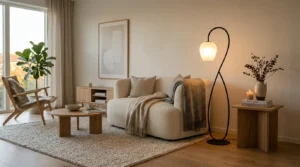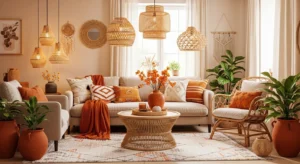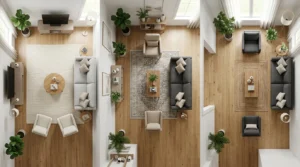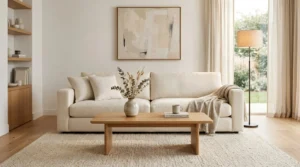
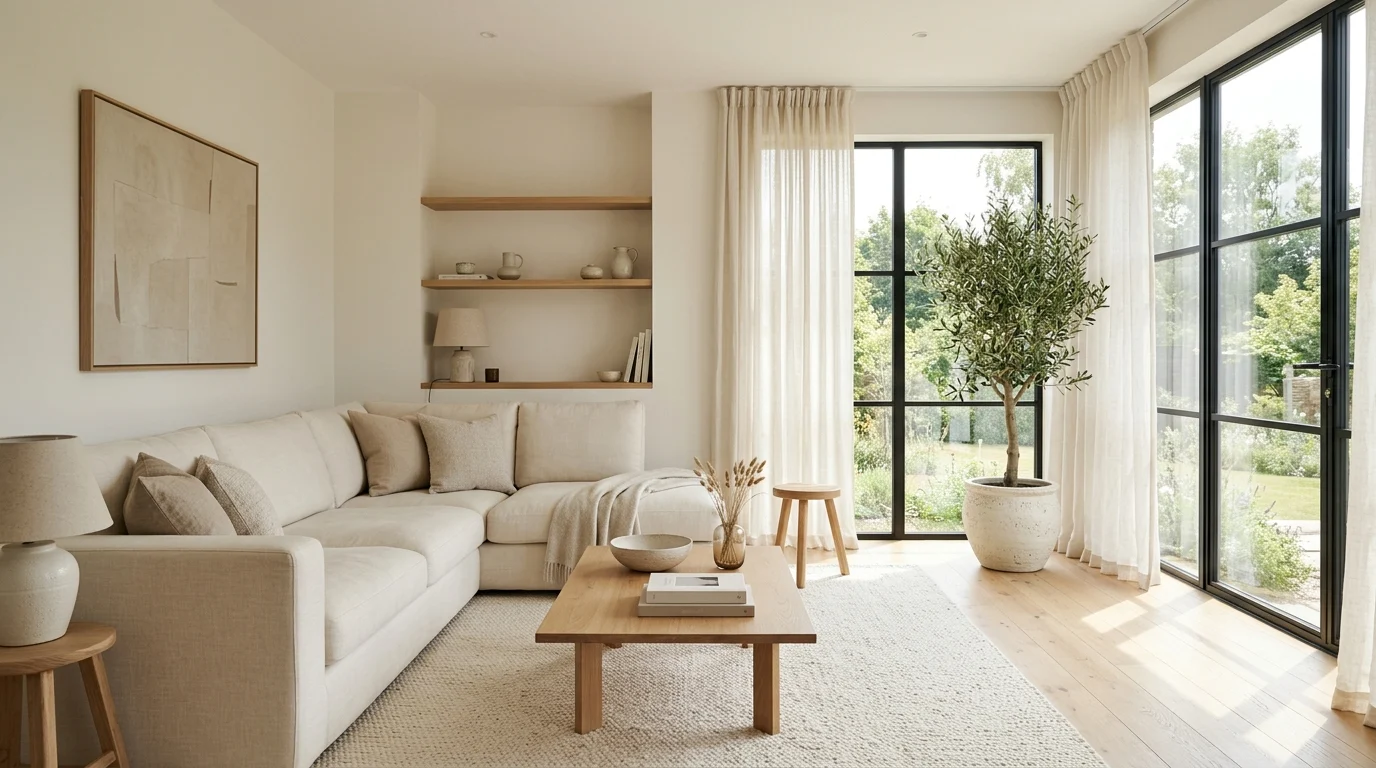
Warm minimalism is not about empty rooms or white boxes that nobody wants to sit in. It is about keeping only what you love, choosing materials that feel good to touch, and letting a room breathe without feeling cold. The difference is in the details: a cream wall instead of a bright white one, a solid oak coffee table instead of a glossy black one, a wool throw that actually gets used on cold evenings. When those choices line up, a living room can look simple and still feel deeply comfortable, even with very little in it. This guide gives you fifteen practical ideas you can use in a small apartment or a large family room. Each one includes real sizes, sensible price ranges, and the mistakes that tend to undo the look, so you can plan with confidence rather than guessing at the shop. Start with one or two ideas, live with them for a week, and then decide what the room still needs.
Start With a Warm White Base, Not a Stark One
A warm white base is the foundation of the whole look, because it sets the tone for every other colour in the room. Choose a white with a soft yellow or beige undertone, such as a warm cream, ivory, or light oat shade, and test it on two walls before committing. Paint swatches look very different in morning light and evening lamplight, so leave samples up for at least two days. For most living rooms, two coats on walls plus a matching warm white on the ceiling keeps the space bright without glare. A standard 3.6 by 4.8 metre room usually needs about 10 litres of wall paint, costing roughly $60 to $140 depending on brand. Avoid pure brilliant white, which can make wood and fabric look grey and cold. Practical tip: paint the trim one shade lighter than the walls for a soft, layered edge rather than a sharp contrast.
Keep Only What Earns Its Place
Warm minimalism works when every object has a clear job or a clear story, and the rest leaves the room. Walk through your living room with a box and remove anything you have not used, loved, or noticed in the past month, then live without it for two weeks before deciding its fate. Aim for open surfaces that are about seventy percent clear, with one or two objects grouped together rather than a row of small items spread across every shelf. A coffee table, for example, looks calm with a stack of two books and a small bowl, not seven ornaments competing for attention. This step costs nothing, though storage baskets or boxes for relocated items may run $20 to $60. Avoid clearing the room so far that it feels like a showroom with nowhere to put a cup of tea. Practical tip: give every remaining item a home, such as a lidded basket by the sofa, so tidying takes two minutes, not twenty.
Choose Low, Soft-Edged Furniture
Low, soft-edged furniture instantly makes a minimalist room feel relaxed rather than formal, because it lowers the visual height of the space and invites people to sink in. Look for a sofa with a seat height of about 43 to 48 centimetres, rounded arms, and no sharp metal legs, paired with a coffee table no higher than 40 centimetres so the proportions stay comfortable. A three-seater sofa around 210 centimetres long suits most family rooms, while a 180-centimetre loveseat works better in a compact space. Expect to spend $600 to $1,500 for a well-made fabric sofa in this style, and $150 to $450 for a simple wooden coffee table. Avoid tall, boxy bookcases and high-backed chairs that chop the room into blocks. Practical tip: leave at least 75 centimetres of walkway around the main seating group so the low furniture still feels open and easy to move around.
Layer Three Textures in Every Seating Zone
Texture is what stops a simple room from feeling flat, and three layers are usually enough to make a seating area feel finished. Start with something smooth, such as a cotton or linen sofa cover, add something soft like a wool or chunky knit throw, and finish with something natural, such as a woven basket, a rattan tray, or a wooden side table. Keep the colours close together — cream, oatmeal, and light taupe, for example — so the contrast comes from touch rather than from bold colour. A good wool throw costs $40 to $110, a woven tray $20 to $45, and a linen cushion cover $15 to $35 each. Avoid mixing five or six textures at once, which can look busy even in neutral colours. Practical tip: drape the throw over one sofa arm only, folded in thirds, so it looks intentional and stays within easy reach on cool evenings.
Bring In Pale Oak and Other Light Woods
Pale oak, ash, and light beech bring warmth to a minimalist room without the heaviness of dark walnut or mahogany, and they pair naturally with cream walls and soft fabrics. Use light wood in one or two places where you will see and touch it often, such as a coffee table, a pair of side tables, or open shelf brackets, and keep the finish matte or lightly oiled rather than glossy. A solid oak coffee table around 110 by 60 centimetres typically costs $250 to $600, while a small oak side table runs $90 to $220. Avoid mixing more than two wood tones in one room, and avoid orange-toned varnishes that fight with warm neutrals. Practical tip: if your floor is already a mid-tone wood, choose furniture one shade lighter or darker than the floor so the pieces stand out gently instead of blending into one flat surface.
Use a Limewash or Warm Plaster Wall
A limewash or warm plaster finish adds subtle movement to a plain wall, giving a minimalist room depth without pattern, pictures, or bold colour. The finish looks mottled and soft, almost like clouds, because it is applied in thin, overlapping brush strokes rather than rolled on flat. One feature wall behind the sofa is usually enough; painting all four walls can feel heavy and costs more for little extra effect. A 4-metre feature wall needs about 5 litres of limewash paint, and a do-it-yourself kit costs $70 to $160, while a professional finish may run $300 to $700 for that wall. Avoid using limewash in a spot that gets frequent knocks from bags or pets, since it marks more easily than standard paint. Practical tip: choose a shade two steps deeper than your other walls, such as warm sand against cream, so the feature wall reads as texture rather than a colour block.
Let Daylight Do the Decorating
Natural light is the cheapest and most effective decoration in a warm minimalist room, because it changes through the day and keeps pale colours looking alive. Start by removing heavy curtains and replacing them with sheer linen panels or light-filtering roller blinds that soften glare without blocking the window. Keep the window sill clear and avoid placing tall furniture directly in front of the glass, so light can reach deep into the room. Sheer linen panels cost about $30 to $80 per panel, and a simple ceiling-mounted track for a 2.4-metre window runs $40 to $100. Avoid dark window frames or heavy pelmets that shrink the window visually, and avoid mirrors placed where they bounce harsh midday sun into seating. Practical tip: hang curtains 10 to 15 centimetres above the window frame and 15 to 20 centimetres wider on each side, so the window looks taller and the room feels more open.
Add One Oversized Piece of Calm Art
One large, calm artwork does more for a minimalist living room than a cluster of small frames, because it gives the eye a single resting place. Choose an abstract artwork in soft tones, a gentle botanical print, or a simple textured canvas in cream, sand, and muted clay, and hang it centred above the sofa or on the longest empty wall. A good size is about 100 by 70 centimetres for a standard three-seater sofa, or 120 by 80 centimetres for a larger wall, hung so the centre sits roughly 145 centimetres from the floor. A framed print in this size costs $80 to $250, while an original canvas may run $300 to $900. Avoid busy, high-contrast art or a gallery wall of ten small pieces, both of which break the calm mood. Practical tip: leave at least 15 to 20 centimetres between the bottom of the frame and the top of the sofa, so the art and the furniture read as one balanced group.
Ground the Room With a Wool Rug in a Warm Neutral
A wool rug in a warm neutral anchors the seating area and stops furniture from looking as if it is floating on a hard floor. Choose a flat or low-pile wool rug in ivory, oatmeal, or light camel, and size it so the front legs of the sofa and chairs all sit on the rug. For a three-seater sofa, a rug around 240 by 170 centimetres usually works, while a larger seating group may need 300 by 200 centimetres. A good-quality wool rug in these sizes costs $250 to $800, and a non-slip rug pad adds $30 to $70 but protects both the rug and the floor. Avoid a rug that only fits under the coffee table, which makes the room look disconnected, and avoid bright white rugs in homes with pets or young children. Practical tip: vacuum weekly and rotate the rug every three months so wear and sunlight fade evenly across the surface.
Style Open Shelving With Breathing Room
Open shelving suits warm minimalism only when it has breathing room, because a shelf packed edge to edge quickly looks like storage rather than styling. Limit each shelf to three or four items, mix one taller object such as a vase with one horizontal stack of books, and leave at least one third of every shelf empty. Keep the colour palette tight — cream ceramics, natural wood, and one muted green plant — so the shelves feel calm even when they hold everyday things. A pair of solid wood floating shelves, each 90 centimetres long, costs $60 to $160, and simple ceramic vases run $15 to $40 each. Avoid lining up books by height alone or filling shelves with small souvenirs from every trip, which creates visual noise. Practical tip: step back three metres after styling each shelf and remove one item; if the shelf still looks complete, that item was not needed.
Mix Warm Metals Sparingly
Warm metals such as brushed brass, soft bronze, and aged copper add a gentle glow to a minimalist room, but they work best in small, repeated touches rather than large statements. Use the same finish in two or three places — for example, a brass floor lamp, a pair of picture-frame edges, and a small bowl on the coffee table — so the metal feels deliberate rather than random. A brushed brass table lamp costs $60 to $150, a floor lamp $120 to $280, and small brass trays or bowls $20 to $50. Avoid mixing brass, chrome, and black metal in one room, and avoid shiny, mirror-polished finishes that can look cold against soft fabrics. Practical tip: choose brushed or matte finishes, which catch light softly and show fingerprints far less than polished metal, making them easier to live with day to day.
Create a Reading Corner That Invites Sitting
A reading corner gives a minimalist living room a human purpose beyond looking tidy, and it only needs a chair, light, and a place for a book. Place a comfortable armchair near a window or a quiet wall, add a floor lamp with a warm bulb behind one shoulder, and keep a small side table within arm’s reach for a cup and a book. An armchair with a seat width of about 65 to 75 centimetres suits most adults, and a side table 45 to 55 centimetres high keeps drinks easy to reach without stretching. A good reading chair costs $300 to $800, a floor lamp $100 to $250, and a side table $80 to $200. Avoid pushing the chair flat against a wall with no light source, which makes the corner feel like an afterthought. Practical tip: add a folded throw over the chair arm and a small basket underneath for two or three current books, so the corner is ready whenever you have ten free minutes.
Use Plants as Sculpture, Not Clutter
Plants bring life and softness to warm minimalism when they are treated as sculpture, with one or two strong shapes rather than a crowded collection on every surface. Choose a tall olive tree, a fiddle-leaf fig, or a sculptural monstera in a simple terracotta or cream pot, and give it a clear spot where its shape can be seen from the sofa. A plant around 120 to 150 centimetres tall suits a standard ceiling, while a smaller trailing plant works on a single high shelf. A healthy large plant in a good pot costs $50 to $150, and a simple ceramic pot runs $25 to $60. Avoid scattering ten small pots across windowsills and shelves, which turns a calm room into a plant shop. Practical tip: water on a fixed weekly schedule, wipe large leaves monthly, and rotate the pot a quarter turn each month so the plant grows evenly toward the light.
Warm Up Lighting With Three Low Levels
Lighting makes or breaks warm minimalism after dark, because one bright ceiling light can flatten every soft colour in the room. Instead, use three low levels: a dimmable ceiling light or pendant for general light, table or floor lamps at seating height for reading and conversation, and a small accent light such as a candle-style lamp on a shelf for glow. Choose bulbs around 2700 Kelvin, which reads as warm and golden, and keep each lamp at a similar warmth so the room does not look patchy. A dimmable pendant costs $80 to $220, a table lamp $50 to $140, and warm LED bulbs $8 to $15 each. Avoid cool white bulbs above 4000 Kelvin, which make cream walls look grey and wood look washed out. Practical tip: put lamps on dimmers or smart plugs so you can lower the light in the evening without getting up, and aim for pools of light rather than one even wash.
Hide Storage Inside Beautiful, Simple Pieces
Hidden storage is what keeps a minimalist room calm in real life, because everyday clutter has somewhere to go without a visible cupboard wall. Choose furniture that stores without shouting about it: an ottoman with a lift-up lid, a coffee table with a lower shelf or drawer, a bench with space inside for blankets, or a sideboard with plain doors for games and chargers. A storage ottoman around 90 by 45 centimetres costs $120 to $300, and a simple oak sideboard runs $350 to $900. Measure your largest items first — board games, extra throws, and charging cables — so the storage you buy actually fits what you need to hide. Avoid glass-fronted cabinets that display clutter, and avoid buying storage before you have cleared out what you no longer need. Practical tip: label the inside of each compartment lightly in pencil, so family members return things to the right place without you having to tidy every night.
Frequently Asked Questions
What is the difference between warm minimalism and regular minimalism?
Regular minimalism often focuses on removing things and using stark white, black, and grey, which can feel cold if taken too far. Warm minimalism keeps the same calm, uncluttered approach but uses cream and oat tones, natural wood, wool, linen, and soft lighting so the room feels inviting. The goal is fewer, better things in materials that feel good to live with, not an empty room.
How do I make a warm minimalist living room feel cozy without adding clutter?
Layer texture instead of adding objects: a wool throw, a linen cushion, a woven basket, and a soft rug can make a room feel cozy while keeping surfaces clear. Warm lighting at 2700 Kelvin, one or two plants with strong shapes, and pale wood also add comfort without visual noise. Keep each surface about seventy percent clear and let texture and light do the work.
Can warm minimalism work in a small living room?
Yes, and it often works better in a small room than a busy style, because fewer objects and pale colours make the space feel larger. Choose low furniture, a rug sized to the seating group, sheer window coverings, and hidden storage such as a storage ottoman. Avoid oversized art and tall bookcases that crowd the walls, and keep one clear walkway of at least 75 centimetres through the room.
Conclusion
Warm minimalism is a practical way to live, not a strict set of rules to follow perfectly. Start with a warm white base, keep only what earns its place, and add texture, light wood, and soft lighting in small, deliberate layers. You do not need to buy everything at once or replace your furniture to get the feeling right. Pick the two or three ideas that fit your room and budget, try them for a few weeks, and adjust based on how you actually use the space. A calm, collected home is one that welcomes you at the end of the day, holds what you need without fuss, and still leaves room to breathe.